About Myosotis forsteri Lehm.
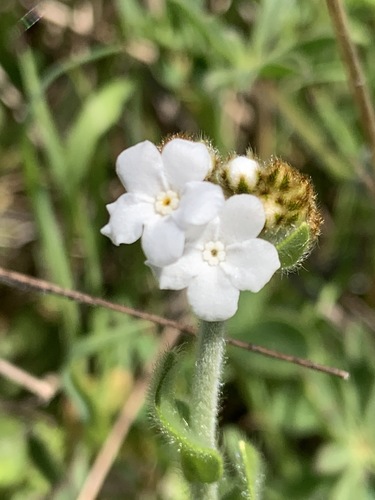
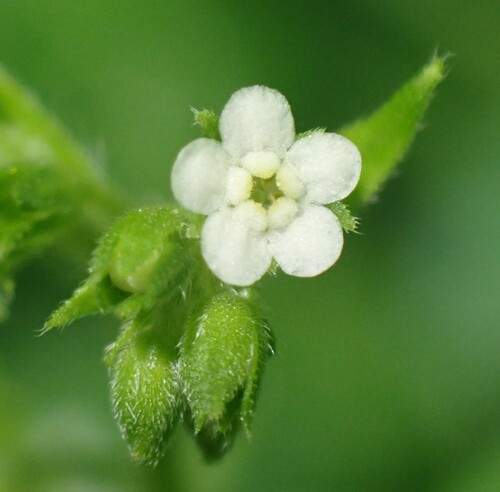
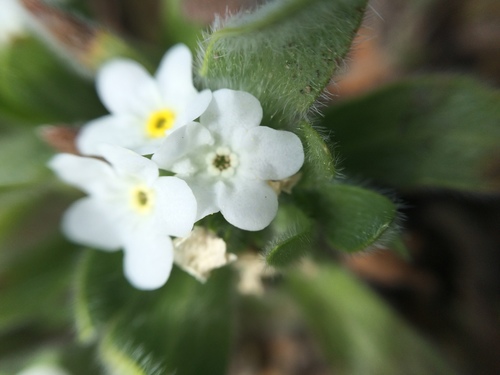
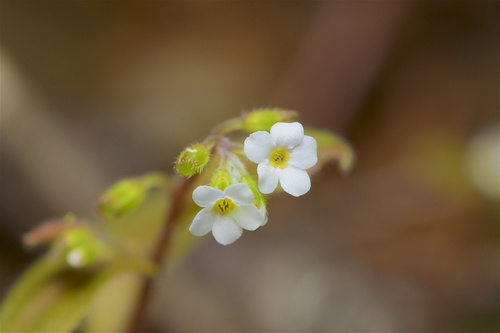
Myosotis forsteri Lehm. plants grow in rosette formations. The rosette leaves have long, narrow petioles that are roughly the same length as the leaf blades, and can be easily distinguished from the leaf blades. Rosette leaf blades measure 15–40 mm long by 10–30 mm wide, and are broadly shaped. Both surfaces of the leaf are uniformly but sparsely covered with appressed, straight, forward-facing (antrorse) hairs. Each rosette produces few to many ascending to erect, sometimes branched, ebracteate inflorescences that can reach up to 300 mm long. Cauline leaves are similar in shape to rosette leaves, but are smaller; they get progressively smaller and become sessile moving toward the top of the inflorescence, and are broadly ovate. Each inflorescence holds many flowers, and each individual flower grows on a short pedicel with no bract. The calyx measures 2.5–5 mm long during both flowering and fruiting, is lobed to one-half of its length or less, and bears hairs mostly on its margins and ribs, some of which are hooked. The corolla is white, has a cylindrical tube, and has small scales that alternate with the petals. The anthers are either included or partially exserted, meaning only the tips of the anthers extend past the scales. The nutlets are approximately 1.2 mm long. The pollen of Myosotis forsteri belongs to the M. uniflora-type. The chromosome number of M. forsteri is unknown. Flowering occurs from October to April, and fruiting occurs from November to May. In terms of its breeding system, Myosotis forsteri is a self-compatible plant that is apomictic or autonomously selfing. Myosotis forsteri is a forget-me-not that grows in forest habitats, often near streams, seepages, or other damp, shaded areas across both the North Island and South Island of New Zealand.