About Myosotis australis R.Br.
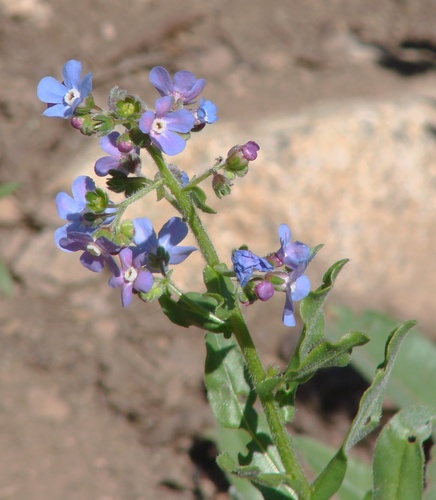
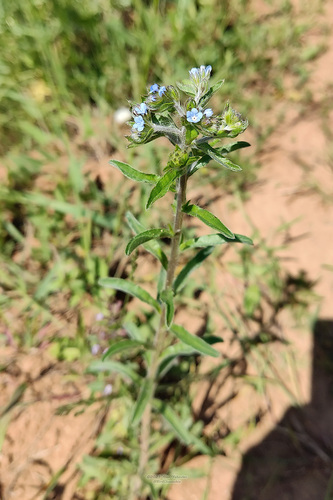
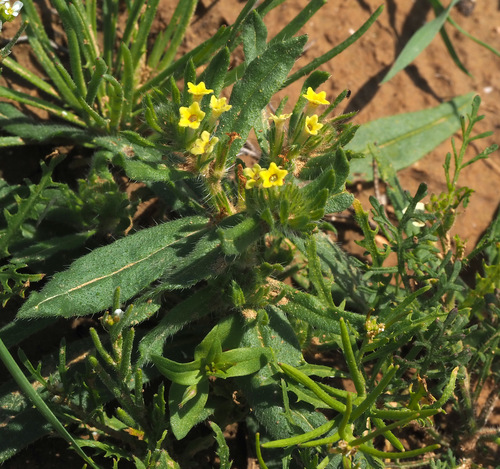
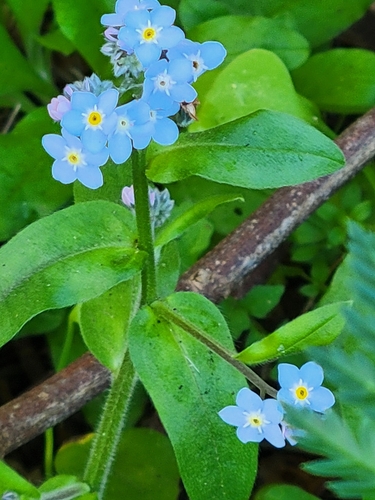
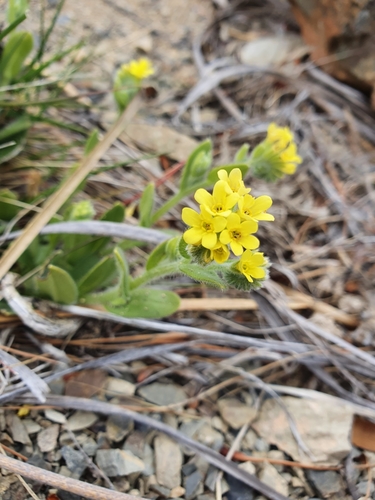
Myosotis australis R.Br. plants grow as rosettes, which are sometimes stoloniferous. Rosette leaves have petioles measuring 1–68 mm long. Their leaf blades are 2–73 mm long and 2–29 mm wide, with a length-to-width ratio of 1.1–7.7:1. Blades are most commonly narrowly oblanceolate, oblanceolate, narrowly obovate, obovate, or very broadly obovate, usually widest at or above the middle, with an acute or obtuse apex. Both leaf surfaces are uniformly and densely covered in flexuous, patent to erect hairs that are oriented parallel or oblique to the midrib. Hairs on the upper leaf surface are antrorse (forward-facing), while hairs on the lower leaf surface are a mix of antrorse and retrorse (backward-facing). Each rosette produces 1–17 ascending to erect inflorescences, which are sometimes lax or decumbent, rarely prostrate or dwarfed, and may be branched or unbranched. Inflorescences are partially bracteate, do not bifurcate at the tip, and grow up to 630 mm long. Cauline leaves resemble rosette leaves but decrease in size up the stem. Each inflorescence holds 3–96 flowers, rarely up to 230, and each flower is borne on a short pedicel, with or without a bract. The calyx is 1–5 mm long when flowering and 2–7 mm long when fruiting, lobed from half to nearly its full length. It is densely covered in straight, flexuous or curved hairs, plus some hooked hairs; nearly all of these hairs are antrorse, with some retrorse backward-facing hairs near the base. Longer calyx hairs are patent to erect, while shorter calyx hairs are appressed to patent. The corolla is white or yellow, 1–10 mm in diameter, with a cylindrical tube, petals that are usually broadly obovate to very broadly obovate, or ovate to very broadly ovate, and small white or yellow scales that alternate with the petals. Anthers are usually fully included within the corolla tube, or sometimes partly exserted. The plant produces four smooth, shiny nutlets, which are usually medium to dark brown. The nutlets are 1.3–2.2 mm long by 0.6–1.7 mm wide, and shaped from narrowly ovoid to broadly ovoid. Pollen of Myosotis australis occurs in australis, uniflora, discolor and intermediate types. The recorded chromosome number for M. australis (cited as M. lytteltonensis; specimen AK 252539) is 2n = 40. Flowering and fruiting occur between September and June in New Zealand and Australia, and can happen year-round in New Guinea. Peak flowering periods are September to December in Australia, November to February in New Zealand, and April to August in New Guinea. Peak fruiting periods are November to March in Australia and New Zealand, and April to August in New Guinea. Myosotis australis is native to New Zealand, Australia and New Guinea. It occurs at elevations from 0–2100 m above sea level in New Zealand and Australia, and from 1775–4350 m above sea level in New Guinea. It grows on rocks, bluffs, outcrops, ledges, scree, or banks. In Australia, it is found in Western Australia, South Australia, New South Wales, Australian Capital Territory, Victoria and Tasmania. In New Zealand, it occurs throughout the South Island in Western Nelson, Marlborough, Canterbury, Westland, Otago, and possibly Fiordland; on the North Island, it is only recorded from the Volcanic Plateau and Southern North Island. In New Guinea, it is found in both Western New Guinea (Mimina and Puncak Jaya) and Papua New Guinea, specifically in the Highlands districts (Chiumbu, Eastern Highlands, Enga, Hela, Southern Highlands, Western Highlands & Jiwaka), Momase districts (Morobe, West Sepik), and Southern districts (Central, Milne Bay).