About Myoporum parvifolium R.Br.
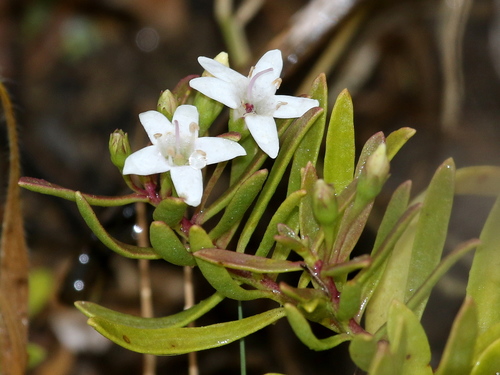
Myoporum parvifolium, commonly known as creeping boobialla, is a prostrate, spreading shrub that sometimes forms a mat up to 3 metres (10 feet) in diameter. Its leaves are fleshy and glabrous, typically 18–40 millimetres (0.7–2 inches) long and 3–6.5 millimetres (0.1–0.3 inches) wide. The leaves are egg-shaped with the narrower end at the base, arranged alternately, and may have a few serrations on the margins near the leaf tip, as well as raised, wart-like tubercles on their surface.
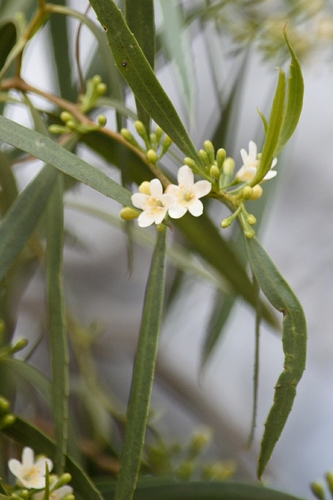
White flowers with purple spots grow in the leaf axils, either singly or in clusters of two or three, on a stalk 7.5–33 millimetres (0.3–1 inch) long. The flowers have five lance-shaped sepals and five petals joined at the base to form a tube. The tube is about 3 millimetres (0.1 inch) long, and the petal lobes are spreading, blunt, 3–4 millimetres (0.1–0.2 inch) long, making the total flower diameter around 7.5 millimetres (0.3 inch). There are four stamens that extend beyond the petals. Peak flowering occurs from winter to summer in New South Wales, and from October to March in South Australia. After flowering, it produces succulent, rounded, yellowish-white fruit that grows up to 8.5 millimetres (0.3 inch) in diameter.
Myoporum parvifolium is distributed in the south-west corner of New South Wales, and from the Eyre Peninsula in South Australia eastwards to Victoria. It is common along much of the Murray River in South Australia, and most often grows on limestone cliffs, along river flats, and in woodland, in sandy, sometimes saline soils.
In horticulture, creeping boobialla is a useful ground cover and is often cultivated for this purpose. It prefers a well-drained, sunny position but is hardy in most growing conditions. It is usually propagated from cuttings, and has been used as a rootstock for harder-to-grow related species such as Eremophila.