About Myoporum boninense Koidz.
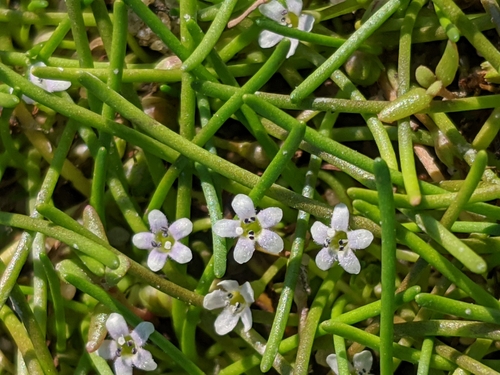
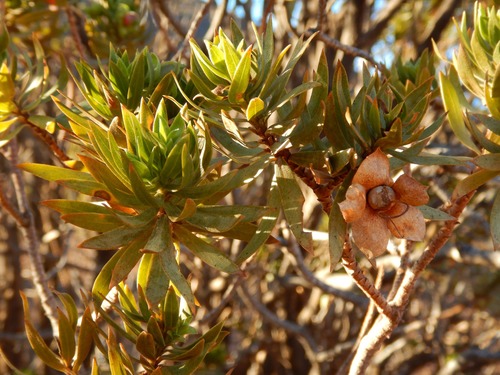
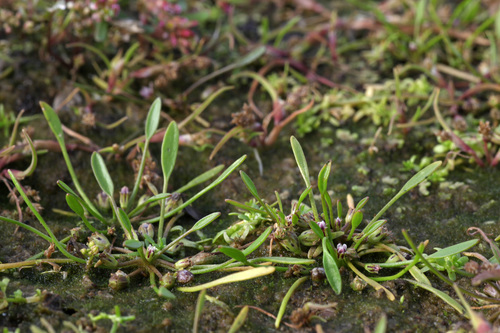
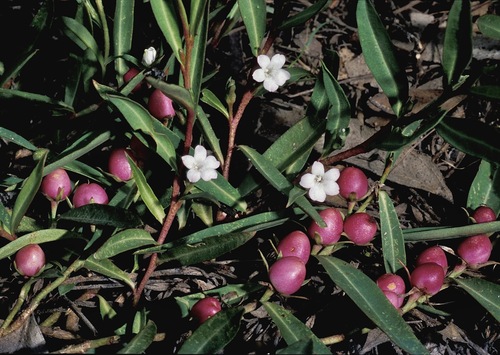
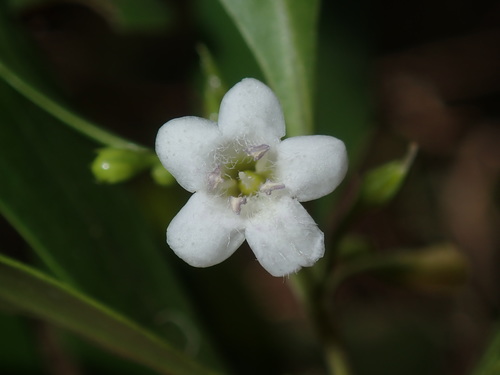
Myoporum boninense Koidz. is a shrub that can be prostrate, erect, or spreading. It grows up to 2 metres (7 ft) tall, and usually does not have the wart-like tubercles found on other species in the Myoporum genus. Its leaves are arranged alternately, typically thick and often fleshy, measuring 12–70 millimetres (0.5–3 in) long and 5.5–36 millimetres (0.2–1 in) wide. Leaves are egg-shaped, sometimes with the narrow end toward the base, and both leaf surfaces are glossy and glabrous. Flowers grow in groups of 1 to 8 on 5–15 millimetre (0.2–0.6 in) long stalks in leaf axils. Each flower has 5 sepals and 5 white petals joined at the base to form a tube. The tube is 2–4 millimetres (0.08–0.2 in) long and hairy in its upper portion, while the petal lobes are 2–3 millimetres (0.08–0.1 in) long and hairy on the inner side. The flower has 4 stamens, which sometimes fill the upper part of the hypanthium. Flowering takes place in spring and summer, and is followed by fleshy drupe fruits. The fruits are 5–10 millimetres (0.2–0.4 in) in diameter, shiny pink, and sometimes cream with purple blotches. This species occurs in coastal habitats, often near the sea, in eastern Australia and on smaller islands located north of eastern Australia. Aboriginal people used the fruit of Myoporum boninense to add flavour to cooked foods. The fruits are usually considered too bitter to eat raw. Myoporum boninense is used in amenity horticulture as a ground cover, and looks its best when trimmed regularly.