About Myophonus caeruleus (Scopoli, 1786)
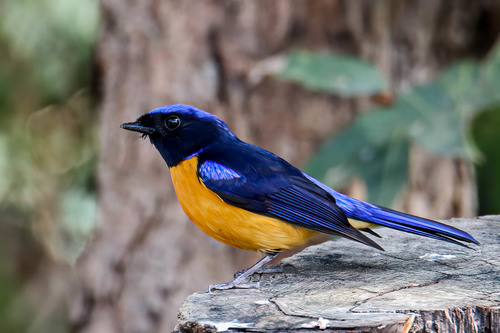
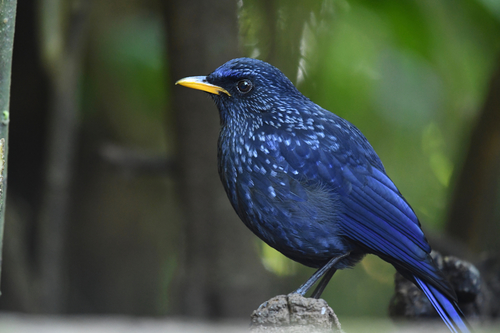
This species, the blue whistling thrush, has the scientific name Myophonus caeruleus (Scopoli, 1786). This whistling thrush has dark violet blue plumage, with shiny spangling on the tips of all body feathers except those on the lores, abdomen, and under the tail. Its wing coverts are a slightly different shade of blue, and the median coverts have white spots at their tips. It has a contrasting yellow bill, and the inner webs of its flight and tail feathers are black. Male and female blue whistling thrushes have similar plumage. The species measures 31–35 cm (12–14 in) in length. Across subspecies, weight ranges from 136 to 231 g (4.8 to 8.1 oz); for comparison, the blue whistling thrush commonly weighs twice as much as an American robin. It is not a true thrush, and belongs to the Old World flycatcher family. Among standard measurements, the wing chord is 15.5–20 cm (6.1–7.9 in) long, the tarsus measures 4.5–5.5 cm (1.8–2.2 in), and the bill measures 2.9–4.6 cm (1.1–1.8 in). Size varies across the species' range, with larger individuals found in the north of the range and slightly smaller individuals found in the south, which follows Bergmann's rule. In northern China, males average 188 g (6.6 oz) and females average 171 g (6.0 oz), while in India males average 167.5 g (5.91 oz) and females average 158.5 g (5.59 oz). Multiple populations have been assigned subspecies status. The nominate subspecies, which has a black bill, occurs in central and eastern China. The Afghan population turkestanicus is often included in the widespread subspecies temminckii, which has a smaller bill width at the base and is found along the Himalayas east to northern Burma. The subspecies eugenei, which lacks white spots on the median coverts, ranges south into Thailand. Cambodia and the Malay Peninsula host the subspecies crassirostris. The subspecies dichrorhynchus, which has smaller spangles, occurs further south and in Sumatra. The Javan population, subspecies flavirostris, has the thickest bill. The subspecies status of several populations is considered questionable. The blue whistling thrush is found along the Tian Shan and Himalayas, in temperate forests, and in subtropical or tropical moist montane forests. Its distribution spans Afghanistan, Bangladesh, Bhutan, Cambodia, China, Hong Kong, India, Indonesia, Kazakhstan, Laos, Macau, Malaysia, Myanmar, Nepal, Tajikistan, Thailand, Tibet, Turkmenistan, Pakistan, and Vietnam. In the Himalayas, this species makes altitudinal movements, descending to lower elevations in winter. Blue whistling thrushes are usually found singly or in pairs. They hop on rocks and move in short quick spurts. They turn over leaves and small stones, cocking their head to check for prey movement. When alarmed, they spread and droop their tail. They are active well after dusk. During the breeding season, which runs from April to August, they tend to sing during the dimness of dawn and dusk, when few other birds are calling. The call most often occurs before sunrise during November. The alarm call is a shrill kree. The nest is a cup-shaped structure made of moss and roots, placed on a ledge or in a hollow beside a stream. The usual clutch has 3 to 4 eggs, and breeding pairs sometimes raise a second brood. Blue whistling thrushes feed on fruits, earthworms, insects, crabs, and snails. They typically batter snails and crabs against a rock before eating. In captivity, they have been recorded killing and eating mice, and in the wild they have been documented preying on small birds. A 2023 study by Perez et al. found that M. caeruleus builds unusually large diameter nests among passerines, with the largest recorded diameter of 10.4 centimetres (4.1 in) among all nests surveyed in their study.