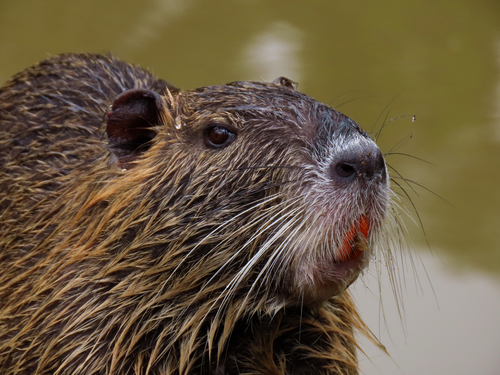
About Myocastor coypus (Molina, 1782)
Nomenclature and Taxonomy
Myocastor coypus, commonly called nutria or coypu, is an herbivorous semiaquatic rodent native to South America. It was long classified as the only member of the family Myocastoridae, but is now placed within Echimyidae, the spiny rat family.
Native Habitat and Diet
Nutria live in burrows along waterways and feed on river plant stems. Their native range covers subtropical and temperate South America, including Chile, Argentina, Uruguay, Paraguay, and the southern parts of Brazil and Bolivia.
Non-Native Introduction
The species was introduced to North America, Europe, and Asia primarily by fur farmers and fur ranchers. Outside its native South America, nutria distribution expands during mild winters and contracts during cold winters.
Cold Weather Impacts
Cold winters often cause frostbite on nutria tails that leads to infection or death, which can result in local or regional extinction, as seen in Scandinavian countries and the U.S. states of Idaho, Montana, and Nebraska during the 1980s. During mild winters, their ranges expand northward; this expansion has recently been observed in Washington, Oregon, and Delaware.
U.S. Introduction History
According to the U.S. Geological Survey, nutria were first introduced to the U.S. in California in 1899 by William Franklin Frakes. As of 2024, they have spread to the San Francisco Bay Area, where their digging activity threatens storm levees, and the California Department of Fish and Wildlife runs an active eradication program for the species.
Louisiana Introduction
Nutria were first brought to Louisiana in the early 1930s for the fur industry, and fur trader trapping kept their population small. The first record of nutria escaping enclosures to spread freely through Louisiana wetlands came in the early 1940s, when an unexpected hurricane destroyed their enclosures and allowed the animals to escape into the wild.
Mississippi River Introduction
Nutria were also transplanted from Port Arthur, Texas to the Mississippi River in 1941, and spread after a hurricane later that year, per the Louisiana Department of Wildlife and Fisheries. Nutria are large extant rodents.
Size and Weight
A mature healthy nutria averages 5.4 kg (11 lb 14 oz) in weight, and can reach up to 10 kg (22 lb). They breed quickly, and each individual consumes large amounts of aquatic vegetation, eating roughly 25% of its body weight daily and feeding year-round.
Feeding Habits
They feed on the base of plants' above-ground stems, and often dig through soil to eat roots and rhizomes. In winter, they target roots, rhizomes, tubers, and black willow tree bark, eating both whole plants and plant parts.
Feeding Impact on Habitat
Their feeding creates areas called "eat-outs" where most above- and below-ground biomass is removed, creating open patches that disrupt habitat for other animals and humans that depend on wetlands and marshes. Recorded plant foods for nutria include cattail, rushes, reeds, arrowheads, flatsedges, cordgrasses, and commercial crops including lawn grasses, alfalfa, corn, rice, and sugarcane.
Preferred Habitats
Nutria are most commonly found in freshwater marshes and wetlands, but also live in brackish marshes, and rarely occupy salt marshes. They either dig their own burrows, or move into abandoned burrows left by beaver, muskrats, or other animals.
Den and Raft Construction
They can build floating rafts from vegetation, and live in partially underwater dens, with the main chamber not submerged underground. Nutria are colonial, with one male sharing a den with three to four females and their offspring.
Feeding Platforms
They build feeding platforms in water from cut vegetation supported by logs or branches; muskrat dens and beaver lodges are also often used as feeding platforms. Nutria herbivory severely reduces overall wetland biomass and can lead to conversion of wetland to open water.
Year-Round Feeding Impact
Unlike annual or infrequent marsh disturbances such as fire and tropical storms, nutria feed year-round, so their impact on marshes is constant. They are typically more destructive in winter than the growing season, because above-ground vegetation is scarce, so they dig up root networks and rhizomes while searching for food.
Co-occurring Wetland Herbivores
While nutria are the most common herbivores in Louisiana marshes, feral hogs, swamp rabbits, and muskrats are also present, and feral hog numbers are increasing in Louisiana wetlands. Plots accessible to nutria have 40% less vegetation than plots fenced to exclude nutria.
Synergistic Disturbance Effects
Herbivory alone does not cause severe land loss, but when combined with additional disturbances such as fire, vegetation removal that simulates tropical storm activity, the effect on vegetation is greatly amplified, resulting in even less total vegetation. Fertilizer added to open plots does not increase plant growth; instead, nutria feed more heavily in fertilized areas, so increasing nutrient inputs only increases nutria biomass rather than the intended wetland vegetation growth, meaning increased nutrient inputs are not recommended for wetland management.
Louisiana Culling Efforts
The problem became so severe in Jefferson Parish that Sheriff Harry Lee deployed SWAT sharpshooters to cull the animals. Wetlands are economically and environmentally valuable resources.
Wetland Biodiversity Value
The U.S. Fish and Wildlife Service found that wetlands cover only 5% of the land area of the contiguous 48 U.S. states, but support 31% of the nation's plant species. These highly biodiverse systems provide resources, shelter, nesting sites, and resting sites (including for migratory birds in Louisiana's coastal wetlands such as Grand Isle) for a wide range of wildlife.
Human Wetland Benefits
Humans also benefit from wetlands, including cleaner water, storm surge protection, oil and gas resources especially on the Gulf Coast, reduced flooding, and chemical and biological waste reduction. Louisiana experiences rapid wetland loss, losing an estimated area equal to a football field every hour.
Louisiana Wetland Damage Surveys
In 1998, the Louisiana Department of Wildlife and Fisheries (LDWF) conducted the first Louisiana coast-wide survey, funded by the Coastal Wetlands Planning, Protection, and Restoration Act as the Nutria Harvest and Wetland Demonstration Program, to evaluate marsh condition. Aerial transect surveys found nutria herbivory damaged roughly 36,000 hectares (90,000 acres) of wetlands.
Damage Trend Data
The following year, repeated surveys found the damaged area had increased to around 42,000 hectares (105,000 acres). LDWF data shows the area of Louisiana wetlands affected by nutria decreased from an estimated minimum of 32,000 hectares (80,000 acres) in the 2002–2003 season to around 2,548 hectares (6,296 acres) in the 2010–2011 season.
Population Control Requirement
LDWF stresses that effective sustainable nutria population control is required for coastal wetland restoration projects to succeed. In 1997 and 1998, Louisiana ran a program to encourage public consumption of nutria meat.
Nutria Meat Nutritional Value
Nutria meat is leaner, lower in fat, and lower in cholesterol than ground beef. Recipes were distributed to local residents and published online to encourage consumption; poor and rural communities in Louisiana have trapped and eaten nutria meat for decades.
Commercial Nutria Meat Sales
A small number of online game meat vendors sell nutria meat for human consumption. In Kyrgyzstan and Uzbekistan, nutria are farmed on private plots and sold in local markets as an affordable meat for low-income people.
Russian Culinary Use
As of 2016, nutria meat is successfully served at the Moscow restaurant Krasnodar Bistro, as part of the growing Russian localvore movement and a popular foodie trend. It is served as burgers, hotdogs, dumplings, or wrapped in cabbage leaves, and its flavor is described as between turkey and pork.
Pet Food Use Proposal
Using nutria meat for dog food treats has been proposed as an environmentally sound solution to invasive nutria. Marsh Dog, a U.S. company based in Baton Rouge, Louisiana, received a grant from the Barataria-Terrebonne National Estuary Program to produce dog food products using nutria meat.
Sustainable Use Recognition
In 2012, the Louisiana Wildlife Federation awarded Marsh Dog the Business Conservationist of the Year award for developing this use for the eco-sustainable protein. Although nutria are still hunted and trapped for their fur in some regions, their destructive burrowing and feeding habits often bring them into conflict with humans, and the species is considered invasive in the United States.
Disease Transmission Risk
Nutria also transmit multiple diseases to humans and animals, primarily through water contamination.


