About Myiozetetes similis (Spix, 1825)
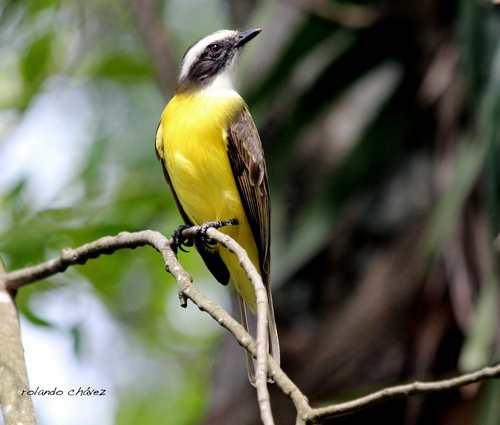
This species, commonly called the social flycatcher, has the scientific name Myiozetetes similis (Spix, 1825). Adults are 16 to 18.5 cm (6.3 to 7.3 in) long and weigh 24 to 27 g (0.85 to 0.95 oz). The sexes share identical plumage, though females average slightly smaller than males. For the nominate subspecies M. s. similis, adults have a dark gray to brownish gray head, with a mostly hidden bright red to orangish red patch at the center of the crown. They have a wide white supercilium that starts on the forehead and extends far past the eye. Their upperparts are mostly dull olive-green to brownish olive, with a somewhat more grayish olive hindneck and grayish brown or grayish olive uppertail coverts. Their wings are deep grayish brown, with pale grayish white edges on the inner secondaries and pale olivaceous edges on the remaining flight feathers. Their wing coverts are olive to brownish olive with grayish white edges, which sometimes form two faint wing bars. Their tail is deep grayish brown with pale olive edges on the feathers. Their chin and throat are white to yellowish white, and their underparts are bright yellow. Juveniles resemble adults but have little to no red on the crown, and wider rufous edges on their wing and tail feathers. All other subspecies of the social flycatcher are very similar to the nominate, differing only slightly in the color tone of the crown patch and the edges of the wing feathers. Subspecies M. s. grandis is larger than the nominate, with wider and paler edges on the wing coverts and slightly brighter underparts. Subspecies M. s. columbianus is the smallest subspecies; it has a lighter gray crown than the nominate, paler edges on the wing coverts, and brighter deeper yellow underparts. All subspecies have a brown iris, a stubby black bill, and black legs and feet. The subspecies of the social flycatcher have the following distributions: M. s. primulus is found in western Mexico from southern Sonora south to northern Sinaloa; M. s. hesperis is found in western Mexico from central Sinaloa and southern Zacatecas east to southwestern Puebla, and south to southeastern Oaxaca, and possibly beyond; M. s. texensis ranges from southwestern Tamaulipas in eastern Mexico south through Belize, Guatemala, El Salvador, Honduras, and Nicaragua into most of Costa Rica; M. s. columbianus ranges from southwestern Costa Rica south through Panama into northern Colombia and northern Venezuela; in Colombia it occurs along the coast and south through the Magdalena River valley to Huila Department, and in Venezuela it ranges east to Sucre and south to northern Amazonas and northern Bolívar states; M. s. similis ranges from Colombia east of the Eastern Andes across Amazonas and southern Bolívar in Venezuela into French Guiana, and south through eastern Ecuador, northeastern and eastern Peru, much of Amazonian Brazil, and northern Bolivia; M. s. grandis ranges from western Esmeraldas Province in western Ecuador slightly south into far northwestern Peru's Tumbes Department; M. s. pallidiventris is found in eastern Brazil roughly bounded by eastern Pará, Paraíba, northern Rio Grande do Sul, and Mato Grosso do Sul, and extends into eastern Paraguay and northeastern Argentina's Misiones Province. The species has also been recorded as a vagrant in the United States, with at least one confirmed record in Texas. The social flycatcher lives in a range of moist to semi-arid landscapes in tropical and lower subtropical zones, most of which are somewhat open. These habitats include lowlands with scattered bushes and trees; secondary forest; the canopy, edges, and shrubby openings in primary forest and woodlands; the margins of lakes and rivers such as gallery forest; agricultural and pasture lands; and gardens and parks in residential areas. In terms of elevation range, it occurs mostly from sea level up to about 1,850 m (6,100 ft) in Mexico and Central America, and reaches as high as 2,250 m (7,400 ft) in Costa Rica. It ranges up to 1,400 m (4,600 ft) in Colombia, to 1,500 m (4,900 ft) north of the Orinoco River and to 500 m (1,600 ft) south of it in Venezuela, to 1,400 m (4,600 ft) in Ecuador, to 1,800 m (5,900 ft) in Peru, and to 1,000 m (3,300 ft) and occasionally higher in Brazil.