About Myiozetetes granadensis Lawrence, 1862
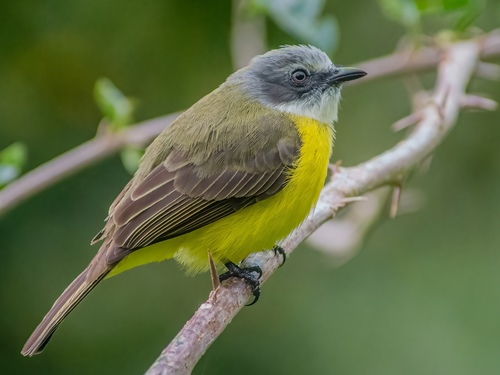
Myiozetetes granadensis, commonly called the grey-capped flycatcher, measures 16 to 18 cm (6.3 to 7.1 in) long and weighs 28 to 30 g (0.99 to 1.1 oz). The sexes have nearly identical plumage. For adult males of the nominate subspecies, the crown and nape are gray, with a mostly hidden orange-yellow to reddish orange patch in the center of the crown. Females sometimes have a smaller patch or no patch at all. Adults of both sexes have a white forehead that extends as a thin supercilium to just past the eye, and they have dusky lores and ear coverts. Most of their upperparts are olive-green, while uppertail coverts are dusky to dark olive with paler edges. Their wings are dusky grayish brown: lesser coverts are pale olive-green, all coverts have olive edges, and remiges are dusky grayish brown with light yellowish olive or cinnamon edges. Their tail is dusky grayish brown, with pale olive edges on its feathers. The chin and throat are white to yellowish white, and underparts are bright yellow with a faint olive tinge on the sides of the breast. Juveniles have a grayish olive tinge on the crown and nape, with little to no orange on the crown. Compared to adults, juvenile grey-capped flycatchers have lighter tawny brown or cinnamon edges on wing coverts, wider, more tawny edges on tail feathers, and slightly paler underparts. Among the recognized subspecies, M. g. occidentalis is slightly smaller than the nominate but otherwise identical, while M. g. obscurior is larger and somewhat darker than the nominate. All subspecies have a pale brownish gray iris, a stubby black bill, and black legs and feet. The grey-capped flycatcher resembles its congener the social flycatcher (M. similis), which has a more pronounced black and white head pattern. The grey-capped flycatcher has a disjunct distribution. The nominate subspecies occurs on the Caribbean slope of eastern Honduras and Nicaragua, extending south along the Caribbean and Pacific slopes through Costa Rica to central Panama. Subspecies M. g. occidentalis ranges from Darién Province in eastern Panama, west of the Andes, south through northern and western Colombia into northwestern Ecuador, reaching northern Manabí Province. Subspecies M. g. obscurior is geographically separated from the other two subspecies, ranging from the lower Magdalena River valley in Colombia south through eastern Ecuador and eastern Peru into northern Bolivia, and from the east side of Colombia's Eastern Andes into Amazonas and western Bolívar states of southeastern Venezuela, plus western Brazil's northern Roraima, western Amazonas, and Rondônia states. The species inhabits a variety of humid tropical and lower subtropical landscapes, most of which are somewhat open. Habitats include edges and shrubby clearings of evergreen forest, secondary forest, gallery forest, and agricultural areas with scattered trees. It is often found near areas of standing water. Overall, its elevation range extends mostly from sea level to 1,650 m (5,400 ft), and it reaches up to 1,800 m (5,900 ft) in Honduras. It reaches 1,500 m (4,900 ft) in Costa Rica, 1,000 m (3,300 ft) in Colombia and Ecuador, 1,400 m (4,600 ft) in Peru, only 550 m (1,800 ft) in Venezuela, and 1,100 m (3,600 ft) in Brazil.