About Myiozetetes cayanensis (Linnaeus, 1766)
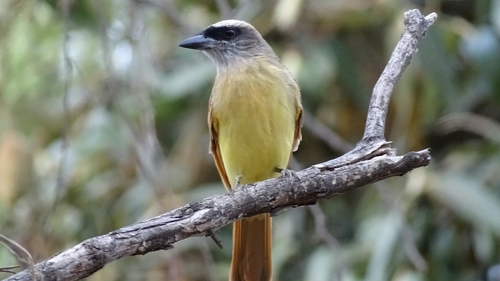
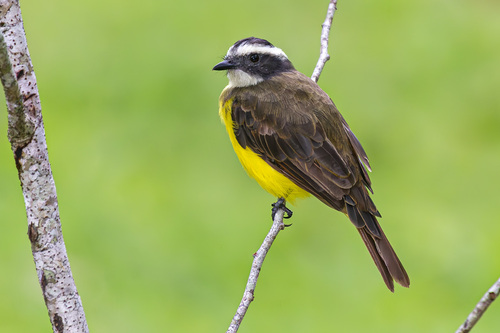
The rusty-margined flycatcher (Myiozetetes cayanensis) is 16.5 to 18 cm (6.5 to 7.1 in) long and weighs 22 to 29.5 g (0.78 to 1.0 oz). The sexes share the same plumage pattern, though females average slightly smaller than males. Adults of the nominate subspecies M. c. cayanensis have a dark sooty brown to blackish brown crown, with a mostly hidden bright yellow to golden-orange patch in the center of the crown. They have a white supercilium that begins on the forehead and extends far past the eye; the rest of their face is dark sooty brown to blackish brown. Their upperparts are plain brown to olive-brown. Their wings are deep grayish brown: the inner secondaries have dull olive edges, the outer secondaries and inner primaries have thin rusty or cinnamon-rufous edges, and the rest of the primaries have thin rufous margins. Their tail is dusky brownish, with light olive edges on the feathers. Their chin and throat are white, and their underparts are bright yellow. Juveniles are similar to adults, but have no yellow crown patch and more extensive rusty-cinnamon edges on their wing and tail feathers.
The four recognized subspecies of the rusty-margined flycatcher differ from the nominate subspecies and one another as follows: M. c. rufipennis has wider, bolder rufous markings on the wings and tail than the nominate. M. c. hellmayri is paler, has more olivaceous upperparts, and less rufous on the primaries than the nominate. M. c. erythropterus is the largest subspecies, and has more prominent rufous markings on the wings. All subspecies have a brown iris, a stubby black bill, and black legs and feet.
Each subspecies has a distinct distribution: M. c. rufipennis is found in Venezuela north of the Orinoco River, ranging south through eastern Colombia and most of eastern Ecuador. M. c. hellmayri occurs on the Pacific slope of Panama in Chiriquí and Veraguas provinces; from the Panama Canal Zone into western Colombia, south through western Ecuador into northern Colombia, and east into the Maracaibo Basin in western Venezuela (Zulia), along the western slope of the Andes from Táchira to Lara. There are at least three records of M. c. hellmayri in far southern Costa Rica, where the subspecies has nested. M. c. cayanensis ranges from southern Venezuela east across the Guianas and northern Brazil, and south through Brazil (excluding the western Amazon Basin) to Mato Grosso do Sul, southeastern Peru's Madre de Dios Department, northern Bolivia, and extreme eastern Paraguay. M. c. erythropterus is found in Rio de Janeiro and the southern and eastern portions of Minas Gerais states in southeastern Brazil. The species has also been recorded as a vagrant in Argentina.
The rusty-margined flycatcher inhabits a variety of partially open landscapes, including cultivated areas, clearings and pastures with shrubs, gallery forest, and the edges of larger continuous forest stands. In the Amazon Basin, it also occurs along rivers and oxbow lakes. In some regions it can be found in ranches, parks, and gardens, but in these areas it tends to stay away from human habitations. Regardless of location, it favors areas near water. Its elevation range varies by country: from sea level to 2,000 m (6,600 ft) in Colombia; up to 1,000 m (3,300 ft) in Ecuador; up to 1,900 m (6,200 ft) north of the Orinoco River and 1,000 m (3,300 ft) south of the Orinoco in Venezuela; and up to 1,000 m (3,300 ft) and locally higher in Brazil.