About Myiotriccus ornatus (Lafresnaye, 1853)
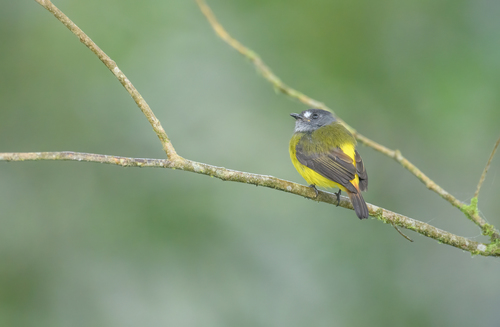
This species, commonly called the ornate flycatcher, has the scientific name Myiotriccus ornatus (Lafresnaye, 1853). Adults measure about 11 to 12 cm (4.3 to 4.7 in) in length and weigh 8.2 to 13.4 g (0.29 to 0.47 oz). Males and females have identical plumage, though females are slightly smaller than males. The nominate subspecies M. o. ornatus has an almost entirely black head, with a white crescent marking in front of the eye and a partially concealed bright yellow patch at the center of the crown. Its back is deep olive, and its rump is bright golden-yellow. The wings are dusky black. The base of the tail is bright rufous, while the outer half of the tail is dusky black. Its throat is gray, its breast is rich olive, and its belly is bright golden-yellow. It has a dark brown iris, black or brown legs and feet, and a black bill. Subspecies M. o. stellatus is much smaller than the nominate. It has a smaller white facial crescent that often has a gap in its middle, and a yellowish base to the tail. Subspecies M. o. phoenicurus has an entirely rufous tail, an iris that ranges in color from gray to dark brown, black or slate legs and feet, and sometimes a creamy white base to the lower mandible of its bill. Subspecies M. o. aureiventris has a slightly lighter green back, lighter gray throat, and lighter green breast than the nominate subspecies. Its iris, legs and feet, and bill match the traits of M. o. phoenicurus. The four recognized subspecies occupy distinct ranges in the Andes. M. o. ornatus is found in the Central Cordillera, and the northern and central portions of the Eastern Cordillera of the Colombian Andes. M. o. stellatus occurs in Colombia's Western Andes, and ranges south along the western Andean slope through Ecuador to El Oro Province. M. o. phoenicurus extends from Caquetá Department in Colombia's Eastern Andes south along the eastern Andean slope through Ecuador, and into northern Peru as far as the Marañón River. M. o. aureiventris is found on the eastern slope of the Peruvian Andes, from Huánuco Department south to Puno Department. The ornate flycatcher lives in humid montane forest, mature secondary forest, and Andean foothill woodlands. It prefers dark mossy ravines and the edges of somewhat open areas, including landslides, gaps created by fallen trees, regrowing clearings, and areas alongside small watercourses. Its elevational range is 600 to 2,400 m (2,000 to 7,900 ft) in Colombia. In Ecuador, it mostly occurs between 800 and 2,000 m (2,600 and 6,600 ft), and occurs at lower elevations in the country's northwest. In Peru, its elevational range is 700 to 2,200 m (2,300 and 7,200 ft).