About Myiothlypis fulvicauda (von Spix, 1825)
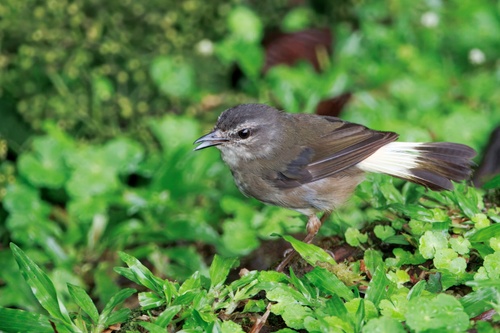
The buff-rumped warbler, Myiothlypis fulvicauda, is a resident New World warbler. Its range extends from Honduras south to northwestern Peru, with an additional disjunct population in the western Amazon. It lives in forests up to 1500 m in altitude, and is always found near water. Breeding pairs construct a bulky domed nest with a side entrance, built on a sloping bank next to a stream or path. The female lays two white eggs, which are incubated for 16–17 days. Chicks take 13–14 days to fledge after hatching. The buff-rumped warbler measures 13–13.5 cm in length and weighs approximately 14.5 g. The nominate subspecies, M. f. fulvicauda, occurs in western Amazonia across Colombia, Ecuador, Peru and Brazil. Nominate individuals are dark olive-brown on the upperparts, with a grey head and a buff supercilium. They have a conspicuous rich buff rump and upper tail, a trait that gives the species both its English common name and its scientific name. The lower half of the tail is blackish, the underparts are whitish, with light buff coloration on the flanks. The sexes have similar plumage. Juvenile birds are browner on the upperparts, head and breast, and have a paler rump than adults. There are five additional recognized subspecies. M. f. semicervina is found in the Chocó region, ranging from eastern Panama to north-western Peru. It resembles the nominate subspecies, but has a larger, paler buff area on the tail and more extensive buff coloration on the flanks. M. f. motacilla, native to Colombia’s Magdalena Valley, is similar to M. f. semicervina, but has a paler buff tail area and more olive-colored upperparts. M. f. leucopygia, which lives on the Caribbean slope of Central America, is a distinctive subspecies: it has a much paler buff rump, a white supercilium, dark legs, and dark spotting across the breast. M. f. veraguensis, from the Pacific slope of Central America, is similar to M. f. leucopygia, but has less breast spotting and a slightly darker rump. M. f. significans, found in south-eastern Peru and northern Bolivia, has a less extensive buff rump than other subspecies, and olive-colored upperparts. This is a common species that is easy to see and identify. It hops on the ground, constantly pumping and swinging its broad tail. It feeds primarily on insects, spiders, and other small invertebrates, which it catches on the ground or in mid-flight in open areas along stream banks, puddles, roadsides, or tracks. Year-round, pairs defend linear feeding territories that follow a stretch of stream. Its call note is a hard tschik that resembles the call of the northern waterthrush. The male’s song is a warble followed by a series of 8–15 ringing chew notes, and the female may respond with a soft vocalization.