About Myiotheretes striaticollis (P.L.Sclater, 1853)
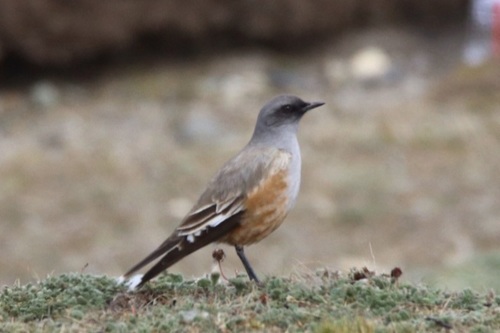
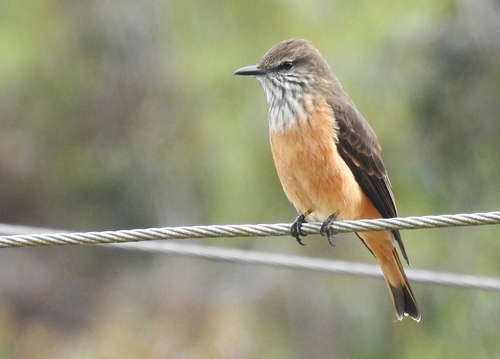
The streak-throated bush tyrant, Myiotheretes striaticollis, is 21 to 23 cm (8.3 to 9.1 in) long and weighs approximately 64 g (2.3 oz). Both sexes have identical plumage. Adults of the nominate subspecies have a dark brown face marked with a faint whitish stripe that runs from the lores past the eye. Their upperparts are a slightly lighter shade of brown, and their wings are mostly dusky, with cinnamon-rufous edges and bases to the flight feathers that form a prominent visible band when the bird is in flight. The upper surface of the tail is dusky, while the underside is cinnamon with a blackish outer third. The throat is white with heavy black streaks that extend onto the breast; the upper breast is pale brown, and the rest of the underparts are cinnamon-rufous. The subspecies M. s. pallidus is smaller and paler than the nominate subspecies, with slightly narrower streaks on the throat. Both subspecies have a dark brown iris, a large slightly hooked blackish bill, and blackish legs and feet. This species has a disjunct distribution across northwestern South America. The nominate subspecies occurs in three separate areas: the Sierra Nevada de Santa Marta in northern Colombia, the Serranía del Perijá on the Colombia-Venezuela border, and a continuous range along the Andes from Táchira and Mérida states in western Venezuela, south through all three Andean ranges of Colombia, the Andes of Ecuador, and the Peruvian Andes as far south as Apurímac and Arequipa departments. M. s. pallidus occurs in the Andes from Cuzco and Puno departments in southern Peru, south through Bolivia into northwestern Argentina, reaching Tucumán Province. The streak-throated bush tyrant lives in a range of semi-open to open landscapes, including shrublands, grasslands, agricultural areas with shrubby patches and small woodlands, and the edges of larger forest and woodland areas, typically near cliffs, landslide scars, and roads. It avoids the interior of large forests. Its elevation range varies by region: it occurs between 2,100 and 3,100 m (6,900 and 10,200 ft) in Venezuela, and likely occurs at higher elevations there; it ranges from 2,400 to 3,400 m (7,900 and 11,200 ft) in Colombia; it is mostly found between 2,400 and 3,200 m (7,900 and 10,500 ft) in Ecuador; and it occurs mostly between 1,700 and 3,700 m (5,600 and 12,100 ft) in Peru, and can be found as low as 500 m (1,600 ft) in that country.