About Myiotheretes fumigatus (Boissonneau, 1840)
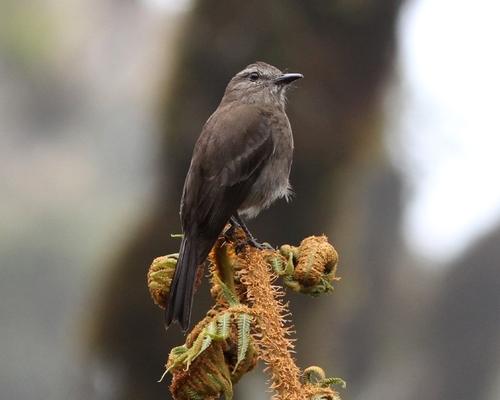
The smoky bush tyrant, Myiotheretes fumigatus, measures 18 to 20.5 cm (7.1 to 8.1 in) in length. Both sexes share identical plumage, which bears a slight resemblance to that of a thrush.
For the nominate subspecies M. f. fumigatus, adults have a thin white supercilium on an otherwise dark smoky brown face. Their upperparts are also dark smoky brown. Their wings are mostly blackish, with buffy edges on the coverts and cinnamon bases on the inner webs of the flight feathers; this cinnamon coloring is clearly visible when the bird is in flight. Their underwing coverts are also cinnamon, which is similarly visible in flight. Their tail is mostly blackish, with whitish edges on the outer feathers. Their chin and throat are mottled whitish and dark brown, with an ochraceous tinge to the throat. Their underparts are mostly dark smoky brown, with dingy buff undertail coverts.
Other subspecies have distinct features: M. f. olivaceus has a dull grayish white supercilium and a brownish vent area. M. f. lugubris has a smaller supercilium than the nominate subspecies and an ochraceous crissum. M. f. cajamarcae is darker overall than the nominate and also has a smaller supercilium. All subspecies have a dark iris, a black bill, and black legs and feet.
The smoky bush tyrant has a disjunct distribution, though the ranges of some of its subspecies adjoin each other. Each subspecies has a separate range: M. f. olivaceus is found in the Serranía del Perijá along the Colombia-Venezuela border, and in the Andes of western Zulia and southern Táchira states in Venezuela. M. f. fumigatus occurs across all three of Colombia’s Andean ranges, extending south into northern Ecuador. M. f. lugubris lives in the Andes from Trujillo to northern Táchira in western Venezuela. M. f. cajamarcae is found in the Andes from Cañar Province in southern Ecuador into Peru, occurring on the western slope as far as Cajamarca Department and on the eastern slope as far as Cuzco Department. The species is present on both slopes of the Andes in Ecuador, and the range of M. f. fumigatus apparently adjoins that of M. f. cajamarcae.
This bird inhabits the interior and edges of humid montane and elfin forest in the upper subtropical and temperate zones. Within this habitat, it mostly lives from the mid-story to the subcanopy, though it also often occurs on shrubby slopes with scattered trees. Its elevation range varies by country: between 2,200 and 3,600 m (7,200 and 11,800 ft) in Venezuela, between 2,000 and 3,600 m (6,600 and 11,800 ft) in Colombia, between 2,000 and 3,200 m (6,600 and 10,500 ft) in Ecuador, and between 2,300 and 3,450 m (7,500 and 11,300 ft) in Peru.