About Myiornis atricapillus (Lawrence, 1875)
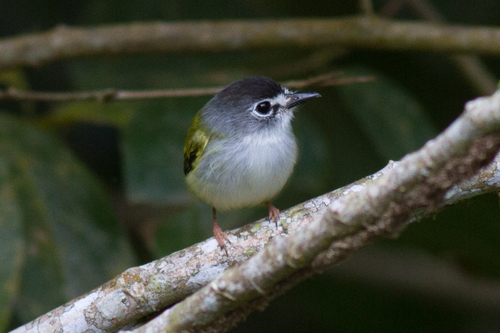
The black-capped pygmy tyrant (Myiornis atricapillus) has a scientific name of Myiornis atricapillus (Lawrence, 1875). Adults measure 6 to 8 cm (2.4 to 3.1 in) in length, and three measured individuals weighed between 5.5 and 6 g (0.19 to 0.21 oz). It is the smallest passerine in Central America, and is counted among the smallest passerines on Earth. Adult males have a black crown that fades to slate gray at the rear of the crown and on the nape. They have white lores that connect to a complete white eye-ring, with a black spot beside the eye on an otherwise slate gray face. The back, rump, and uppertail coverts are bright olive green. The greater and median wing coverts are slate black with olive green tips, while the lesser wing coverts are bright olive green. The tail is very short. The flight feathers (remiges and rectrices) are slate black with olive green to yellowish edges. The throat is white; the breast is white with pale gray sides, and the belly, flanks, and undertail coverts are pale yellow. The iris is brown to dark brown, the bill is black with a small white tip on the lower mandible, and the legs and feet are pale brown, pink, or orangish. Adult females are similar to males, but their crown is mostly dusky slate, with dull black only on the front portion. Juveniles of both sexes resemble adult females. Most sources document the black-capped pygmy tyrant's range along the Caribbean slope of Costa Rica and Panama extending as far as Darién Province; it occurs on both slopes within Darién, extends into central Colombia as far as Santander Department, and continues along the Pacific slope of Colombia into northwestern Ecuador reaching as far as the northern parts of Manabí and Santo Domingo de los Tsáchilas provinces. The Cornell Lab of Ornithology's Birds of the World additionally notes two early 21st century records from southeastern Nicaragua. The species primarily inhabits the interior of humid lowland and foothill tropical zone forest. It can also be found in mature secondary forest, semi-open forest, and at forest edges and in forest gaps. There are a small number of reports of the species occurring in scrubby fields and cacao plantations. In terms of elevation, the species ranges from sea level up to 600 m (2,000 ft) in Costa Rica, to 750 m (2,500 ft) in Panama, to 1,300 m (4,300 ft) in Colombia, and to 800 m (2,600 ft) in Ecuador.