About Myiophobus flavicans (P.L.Sclater, 1861)
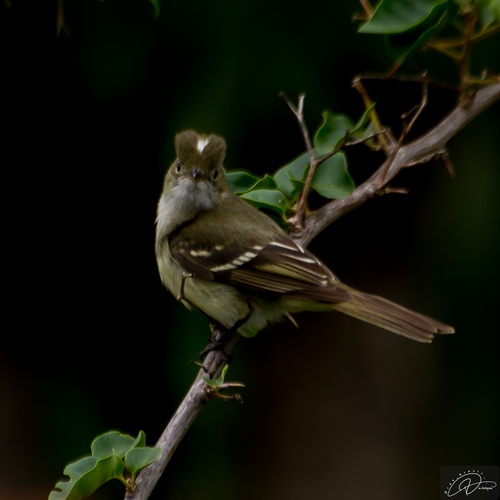
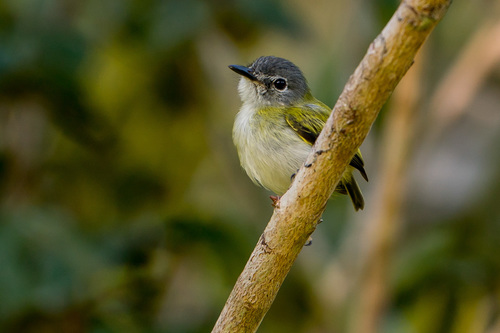
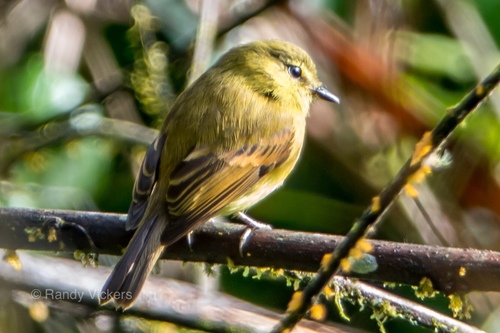
The flavescent flycatcher, Myiophobus flavicans, is 12 to 13 cm (4.7 to 5.1 in) long and weighs 10.2 to 12.9 g (0.36 to 0.46 oz). The sexes have almost identical plumage. Adult males of the nominate subspecies M. f. flavicans have an olive crown with a mostly hidden yellow or orange patch in the center, while females do not have this patch. Both sexes have a yellowish line above the lores and a thin, broken yellowish eye-ring on an otherwise olive face. Their back and rump are olive. Their wings are dusky, with cinnamon edges on the flight feathers and cinnamon to ochraceous tips on the wing coverts; the tipped coverts form two or three wing bars. Their tail is dusky, with buffy olive edges on the feathers. Their throat and underparts are yellow, with the brightest yellow on the belly, and the breast has faint olive streaks. All subspecies have a dark iris, black legs and feet, and a somewhat broad bill. One source notes the bill has a black maxilla and a brownish to dusky pinkish mandible, while other sources describe the bill as entirely black. The other subspecies differ from the nominate subspecies and each other as follows. M. f. venezuelanus is smaller, always has a yellow crown patch, has less olive on the breast than the nominate, and has a pinkish mandible. M. f. caripensis is similar to M. f. venezuelanus, but has a brighter yellow breast with even less olive. M. f. perijanus is similar to M. f. venezuelanus, but has an all black bill. M. f. superciliosus has yellower lores and eye-ring than the nominate, one thin cinnamon wing bar, dull brown edges on the flight feathers, and an all black bill. The subspecies of the flavescent flycatcher have the following ranges. M. f. flavicans is found across all three ranges of the Colombian Andes, extending south along both Andean slopes through Ecuador into northern Peru as far as the Marañón River. M. f. perijanus occurs in Venezuela, in the Serranía del Perijá and the Andes of southern Táchira state. M. f. venezuelanus occurs in Venezuela, in the Andes from northern Táchira to Lara, and in the Coastal Ranges from Yaracuy east to Miranda. M. f. caripensis is found in Venezuela, in western Sucre and northern Monagas states. M. f. superciliosus occurs on the eastern slope of the Peruvian Andes, from the Marañón River south to Cuzco Department. The flavescent flycatcher primarily inhabits the interior and edges of humid to wet forest in the subtropical and lower temperate zones. In some areas it favors stands of bamboo. Its elevation range is between 1,500 and 2,800 m (4,900 and 9,200 ft) in Colombia, between 1,300 and 2,500 m (4,300 and 8,200 ft) in Ecuador, between 1,500 and 2,300 m (4,900 and 7,500 ft) and locally to 3,000 m (9,800 ft) in Peru, and between 900 and 2,300 m (3,000 and 7,500 ft) in Venezuela, where it occurs mostly above 1,300 m (4,300 ft).