About Myiophobus fasciatus (Statius Muller, 1776)
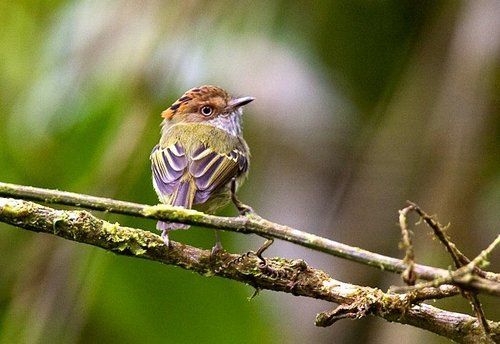
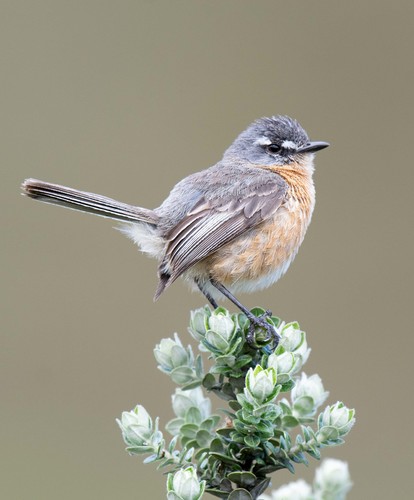
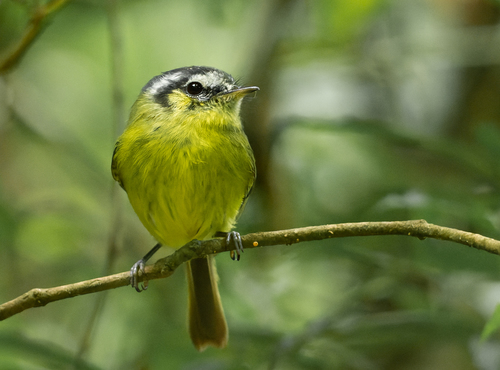
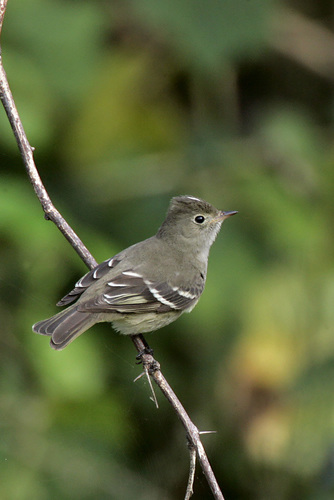
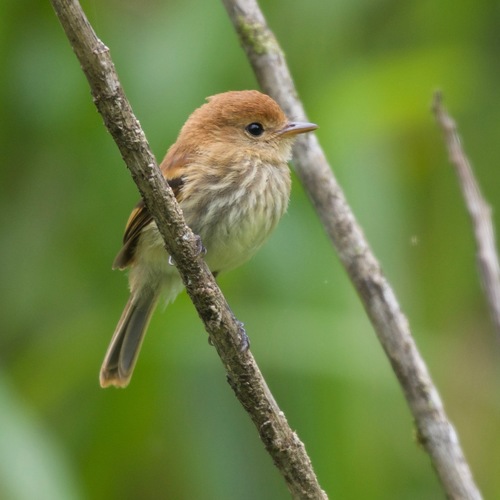
The bran-colored flycatcher, Myiophobus fasciatus (first described by Statius Muller in 1776), measures 11 to 14 cm (4.3 to 5.5 in) in length and weighs 7.1 to 17 g (0.25 to 0.60 oz). The sexes are very similar in appearance. For adult males of the nominate subspecies M. f. fasciatus, the crown is reddish brown, with a partly hidden yellow to orange-rufous patch in the center. Both sexes have brown lores, a short yellowish white line above the lores, and a thin white eye-ring on an otherwise reddish brown face. Their back and rump are reddish brown. Their wings range from dusky to dark brown; flight feathers have thin buff edges, and wing coverts have wide buff-white tips that form two distinct wing bars. Their tail is dark brown. Their throat and underparts are mostly dull white, marked with short grayish brown streaks that are dense on the breast and flanks. The belly sometimes has a faint yellow tinge. Adult females have a much smaller crown patch, or none at all, and their underparts are less heavily streaked than those of males. All subspecies of the bran-colored flycatcher have a dark brown, cinnamon-brown, or brown iris, and black legs and feet. Most subspecies have a black or blackish gray upper mandible (maxilla), and a dark lower mandible with an orange-yellow, brownish pink, or pinkish gray base. The five recognized subspecies differ from the nominate subspecies and from each other in the following ways: M. f. furfurosus has the richest reddish-brown upperparts of all subspecies, a yellower belly than the nominate, rufous-white wing bars, and an orange-yellow or pinkish mandible. M. f. saturatus is duller overall than the nominate, with brown upperparts that lack rufous tones and a deeper yellow belly. M. f. auriceps has darker brown upperparts and darker brown breast streaking than the nominate, with a white belly; populations in Brazil have somewhat more buffy underparts and more cinnamon-colored wing bars. M. f. flammiceps is the largest subspecies, with warmer brown upperparts than the other subspecies and a white belly washed with yellow, and a pale mandible. The bran-colored flycatcher has a disjunct distribution, with each subspecies occupying a separate range: M. f. furfurosus is found from southern San José Province in southwestern Costa Rica south through Puntarenas Province into Panama, extending just past the Canal Zone, and also occurs on the Pearl Islands off Panama's Pacific coast. The nominate M. f. fasciatus occurs along most of the length of the three ranges of the Colombian Andes; in eastern Ecuador; in Venezuela, it is found in the Serranía del Perijá, across most of northern Venezuela, and in western Amazonas and central Bolívar states, and is likely present throughout these areas; it also occurs coastally across the Guianas, and in northern Brazil in the states of Roraima, Amapá, and northernmost Pará. M. f. saturatus is found in Amazonian and east Andean foothills of Peru, between the departments of San Martín and Cusco. M. f. auriceps occupies southeastern Peru, Acre state in western Brazil, northern and eastern Bolivia, western Paraguay, and Argentina as far south as Buenos Aires Province. M. f. flammiceps is found across roughly the eastern half of Brazil, eastern Paraguay, Uruguay, and northeastern Argentina. Across its wide range, the bran-colored flycatcher lives in a variety of somewhat open landscapes. These include the interior and edges of dry forest, brushy savanna and pastures, and thickets along watercourses in arid areas. It also lives in successional vegetation on riverbanks and river islands, and in the Llanos of Colombia and Venezuela. Its recorded elevation range varies by region: 700 to 1,250 m (2,300 to 4,100 ft) in Central America; 600 to 2,000 m (2,000 to 6,600 ft) in Colombia; up to 1,700 m (5,600 ft) north of the Orinoco River and up to 1,200 m (3,900 ft) south of the Orinoco in Venezuela; 300 to 1,100 m (1,000 and 3,600 ft) in Ecuador; up to 1,800 m (5,900 ft) in Peru; and from sea level to 1,500 m (4,900 ft) in Brazil.