About Myiopagis viridicata (Vieillot, 1817)
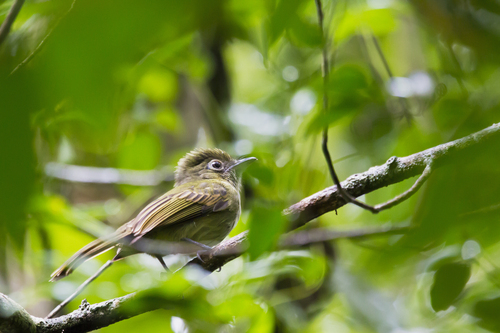
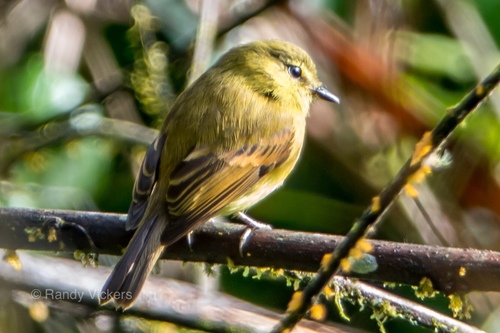
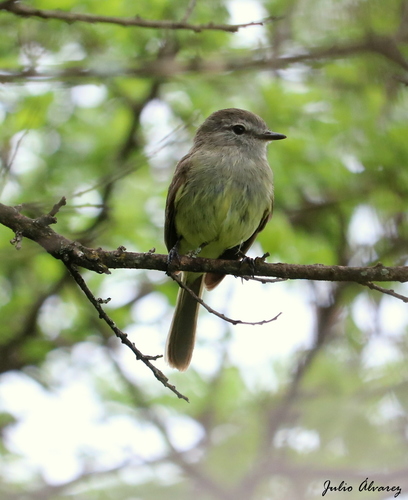
Greenish elaenia (Myiopagis viridicata) measures 13 to 14 cm (5.1 to 5.5 in) long and weighs 11 to 13 g (0.39 to 0.46 oz). The sexes have essentially identical plumage. Adults of the nominate subspecies M. v. viridicata have a greenish olive crown with a faint grayish tinge, and a partially concealed bright yellow stripe along the center of the crown; males have a larger yellow patch than females. Adult greenish elaenia have a dark loral streak, a whitish gray supercilium, a partial white eyering, and grizzled whitish ear coverts. Their upperparts are olive-green, their wings are dusky with yellowish edges on the inner flight feathers and yellowish tips on the coverts, and their tail is dusky olive. Their throat is pale gray to whitish, their breast is pale grayish white with variable light olive streaks, and their belly and undertail coverts are pale yellow. All subspecies of both sexes have a dark brown to reddish brown iris, a short brownish black or black bill with a lighter base to the mandible, and blackish to dark gray legs and feet. Other subspecies of the greenish elaenia differ only slightly from the nominate subspecies and from one another. The distinguishing traits are: M. v. jaliscensis is paler than all other subspecies; M. v. minima is smaller than all other subspecies; M. v. placens has brighter green upperparts than the nominate; M. v. pacifica has duller olive upperparts and a paler yellow belly than the nominate; M. v. accola has brighter green upperparts and a larger bill than the nominate; M. v. pallens is similar to accola but slightly paler overall; M. v. restricta is similar to pallens but somewhat larger; M. v. zuliae has brighter green upperparts and a brighter yellow belly than the nominate; M. v. implacens is smaller than pallens, restricta, and zuliae, has black on the edges of the crown, and has a brighter green back and brighter yellow markings on the flight feathers and wing coverts than the nominate. The greenish elaenia has a significantly disjunct distribution, with each subspecies occupying a separate range: M. v. jaliscensis is found in western Mexico, from southern Durango and Nayarit south to Guerrero and southern Oaxaca; M. v. minima is found on the Tres Marías Islands off Nayarit, Mexico; M. v. placens is found on the Caribbean slope from Tamaulipas in northeastern Mexico south through Belize and Guatemala into Honduras, including the Yucatán Peninsula and Cozumel Island; M. v. pacifica is found on the Pacific slope from Chiapas in southern Mexico south through Guatemala and El Salvador to Honduras; M. v. accola ranges from Nicaragua south along the Pacific slope through Costa Rica and Panama into northern Colombia and northern Táchira in northwestern Venezuela; M. v. pallens is found in Colombia, in the Sierra Nevada de Santa Marta and its surrounding area, and the valleys of the Cauca and Magdalena rivers; M. v. restricta is found in Venezuela east of the Andes and north of the Amazon River, and extends into Guyana and Suriname; M. v. zuliae is found in the Serranía del Perijá on the Colombia-Venezuela border; M. v. implacens ranges from Nariño Department in southwestern Colombia south through western Ecuador, just into Tumbes Department in far northwestern Peru; M. v. viridicata (the nominate) is found in southeastern Peru, northern and eastern Bolivia, central, eastern, and southeastern Brazil, eastern Paraguay, northeastern Argentina, and far northern Uruguay. The greenish elaenia inhabits a wide variety of mostly wooded landscapes, with no strong concentration in just one or a few landscapes across most of its range. It can be found in humid tropical evergreen forest, gallery forest, semi-deciduous and deciduous forest, taller scrublands, mature secondary forest, and citrus and coffee plantations. It does favor várzea habitat in Peru. In terms of elevation range, it occurs up to 1,500 m (4,900 ft) in Mexico and Central America, up to 1,200 m (3,900 ft) in Colombia, mostly up to 500 m (1,600 ft) and locally up to 1,000 m (3,300 ft) in Ecuador, up to 1,000 m (3,300 ft) in Peru, up to 1,000 m (3,300 ft) in western Venezuela and 300 m (1,000 ft) east of the Andes in Venezuela, and up to 1,100 m (3,600 ft) in Brazil.