About Myiodynastes maculatus (Statius Muller, 1776)
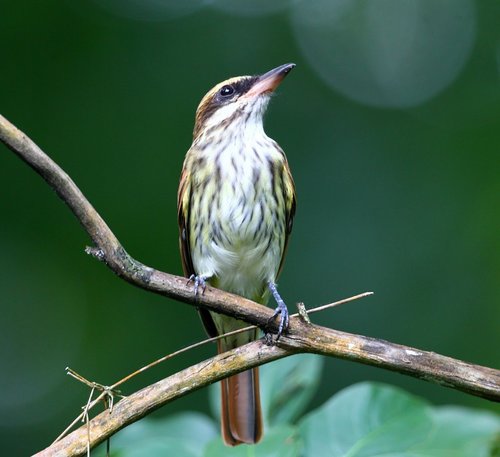
The streaked flycatcher (Myiodynastes maculatus) has a scientific binomial name of Myiodynastes maculatus, first described by Statius Muller in 1776. This species measures 20.5 to 23 cm (8.1 to 9.1 in) in length and weighs 36.5 to 50 g (1.3 to 1.8 oz), with both sexes sharing identical plumage. Adults of the nominate subspecies M. m. maculatus have an olive to olive-brown crown and nape; individual feathers have thin cinnamon edges, and a large, partially hidden bright yellow to orange-yellow patch sits in the center of the crown. These birds have black lores that extend into the ear coverts to form a dark mask. They have a dull white to yellowish, rather blurry supercilium, and a white streak below the dark mask. From the upperparts down to the upper rump, the plumage is grayish brown to olive; feathers have buffy edges and dusky shafts that create a streaked appearance. The lower rump and uppertail coverts are cinnamon-rufous, marked with black or dusky streaks. The wings are dusky, with pale cinnamon-rufous edges on the lesser coverts, and thin cinnamon-rufous edges on the outer webs of the other coverts and most flight feathers. The tail is mostly cinnamon-rufous, with dusky to black coloring along the feather shafts that appears as streaks. The chin and most underparts are white, with yellowish coloring on the flanks, lower belly, and undertail coverts. The throat has thin dusky streaks, while the breast and flanks have thicker, heavier streaks. Juveniles do not have the adult crown patch, and have more rufous coloration on their tail feathers. The species' other subspecies differ from the nominate subspecies and from each other as follows: M. m. insolens has more olivaceous upperparts with thinner streaks, a more yellowish supercilium, and thinner streaks on the wings and underparts. M. m. difficilis is paler overall, with a buff crown and hindneck, and buffy edges along the dark streaks on the upperparts. M. m. nobilis has paler, buffier upperparts, more yellow wash on the underparts, and less heavy underpart streaking. M. m. chapmani is similar to M. m. nobilis, but has a wide, distinct supercilium and slightly heavier streaks on the underparts. M. m. tobagensis has wide pale edges on head and upperpart feathers, a warmer yellow belly, and heavier streaks on the breast and flanks. M. m. solitarius has much less overall rufous coloration than the other subspecies, with much wider blackish streaking across its entire body; its crown and tail appear almost fully black. All subspecies have a brown to dark brown iris, a black bill with a pinkish to pinkish brown base on the lower mandible, and gray to black legs and feet. Each subspecies of the streaked flycatcher has a distinct distribution: M. m. insolens occurs on the Gulf-Caribbean slope from southern Tamaulipas in Mexico south, including the southern Yucatán Peninsula, through Belize, northern Guatemala, and northwestern Honduras into northern Nicaragua; it migrates to Colombia. M. m. difficilis ranges from southwestern Nicaragua south through western Costa Rica, through Panama including its offshore islands, and across central Colombia into western Venezuela, passing through Zulia and Táchira to Portuguesa. M. m. nobilis ranges across Colombia from northern Córdoba Department including the Sierra Nevada de Santa Marta into the western Serranía del Perijá. M. m. chapmani ranges from Chocó Department in western Colombia south through western Ecuador into extreme northwestern Peru's Piura Department. The nominate subspecies M. m. maculatus is found in Suriname, French Guiana, and northern Brazil north of the Amazon, from the upper Negro River east to northwestern Maranhão. M. m. tobagensis is found in most of Venezuela except western Venezuela, as well as Venezuela's Margarita Island, Trinidad, Tobago, and Guyana. M. m. solitarius ranges from eastern Peru east across Brazil, and extends south from there through eastern Bolivia, Paraguay and Uruguay into Argentina as far as La Pampa and northwestern Buenos Aires provinces; it migrates as far north as northern South America. The species has also been recorded as a vagrant on Bonaire and in Chile. The streaked flycatcher inhabits the canopy and edges of a variety of forested landscapes in the tropical and lower subtropical zones. These habitats include evergreen and deciduous forest, gallery forest, várzea forest, mangroves, and clearings with some tall trees within larger forest areas. In Mexico and Central America, it occurs from sea level up to 1,750 m (5,700 ft), though it is mostly found below 1,500 m (4,900 ft) in northern Central America and below 1,200 m (3,900 ft) in Costa Rica. In Colombia and Venezuela, it ranges from sea level to 2,000 m (6,600 ft); in Brazil, it reaches up to 1,500 m (4,900 ft); in Ecuador, up to 1,000 m (3,300 ft); and in Peru, it reaches 2,000 m (6,600 ft). It reaches 1,350 m (4,400 ft) in Argentina, and 2,100 m (6,900 ft) in Bolivia.