About Myiarchus tyrannulus (Statius Muller, 1776)
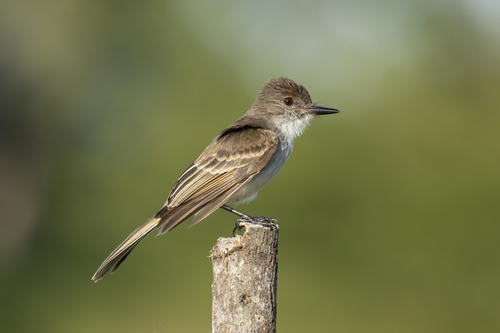
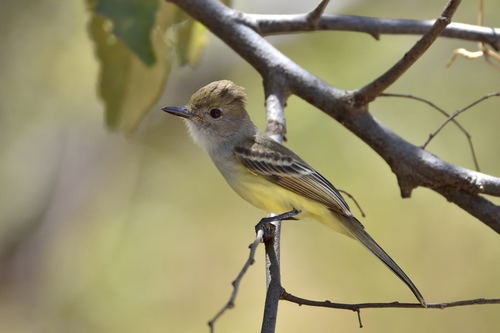
The brown-crested flycatcher, Myiarchus tyrannulus (first described by Statius Muller in 1776), measures 18 to 23 cm (7.1 to 9.1 in) in total length, with body size decreasing from the northern to southern parts of its range. The subspecies M. t. magister is the largest taxon in the entire genus Myiarchus, weighing 36 to 54 g (1.3 to 1.9 oz), while other subspecies weigh 21 to 45 g (0.74 to 1.6 oz). Males and females have identical plumage. For adults of the subspecies M. t. magister and M. t. cooperi, the crown is grayish brown with darker feather shafts that form a bushy crest. Their upperparts are mostly light brownish gray to dark olive gray, and the uppertail coverts often carry a rufous tinge. The rest of the face is medium gray. Their wings are mostly dark grayish brown to brownish black; all but the outermost primaries have rufous edges, while the secondaries have white, pale lemon, or grayish edges. The greater and median wing coverts have pale grayish brown to brownish white tips that form two distinct wing bars. Their tail is dark grayish brown to brownish black, with rufous inner webs on all feathers except the innermost pair. The throat and upper breast are light gray, with the throat being slightly paler than the breast. The lower breast, flanks, and belly are bright yellow with a light gray wash along the sides, and the undertail coverts are light yellow. Other subspecies differ from M. t. magister, M. t. cooperi, and from each other as follows: M. t. cozumelae has a darker, browner crown, darker, browner upperparts and uppertail coverts, darker rufous coloring on the tail, and a paler belly; M. t. insularum has darker upperparts and slightly darker underparts; M. t. brachyurus is the smallest subspecies found in North and Central America, and has more rufous coloring on the tail feathers; M. t. tyrannulus is similar in appearance to M. t. magister and M. t. cooperi; M. t. bahiae is also similar in appearance to M. t. magister and M. t. cooperi. Most individuals of the brown-crested flycatcher have a brown iris, a black bill that sometimes has a paler base, and black legs and feet. The subspecies of the brown-crested flycatcher have disjunct distributions, occurring separately within Central America, within South America, and between the two regions. The species' range goes around most of the Amazon Basin. Each subspecies has its own distinct range: M. t. magister is found from southeastern California, southern Nevada, southwestern Utah, south-central and southeastern Arizona, and southwestern New Mexico in the United States, south through western Mexico to eastern Oaxaca, and also on the Tres Marias Islands; M. t. cooperi ranges from southern Texas in the United States south through eastern Mexico (including the Yucatán Peninsula), Belize, and northern Guatemala into northern Honduras; M. t. cozumelae is restricted to Cozumel Island; M. t. insularum is found on the Bay Islands off Honduras' Caribbean coast; M. t. brachyurus occurs in western Nicaragua and northwestern Costa Rica; M. t. tyrannulus is found on Aruba, Bonaire, Curaçao, Trinidad, and Tobago, in northern and eastern Colombia, northern and central Venezuela, the Guianas and adjacent Brazil north of the Amazon and east of the Negro River, western Brazil from Acre to western Mato Grosso do Sul, extreme southeastern Peru, northern and eastern Bolivia, western Paraguay, and northern Argentina south to Córdoba and Santa Fe provinces, with a separate population in northern Peru; M. t. bahiae occurs in eastern Brazil from Pará south to São Paulo state, eastern Paraguay, and Misiones Province in northeastern Argentina. The brown-crested flycatcher has been recorded as a vagrant in the U.S. states of Louisiana and Florida. Unconfirmed sight records of M. t. tyrannulus in Ecuador have led the South American Classification Committee of the AOS to classify the species as hypothetical in that country. Across its extremely large range, the brown-crested flycatcher inhabits many different types of landscapes, with the only shared requirement being large cavities in trees or cacti for nesting. Subspecies M. t. magister primarily lives in riparian zones, and also occurs in relatively high-elevation deserts that host saguaro and other large cacti. It is found less often in mesquite deserts, thorn forests, pine-oak woodlands, and deciduous woodlands, and occurs from sea level up to 2,000 m (6,600 ft) in elevation. Across most of its range, M. t. cooperi inhabits the same types of landscapes as M. t. magister, but is distributed somewhat more evenly across the different habitat types. From southern Mexico southward, it also occurs in tropical deciduous forest, secondary forest, swamp forest, gallery forest, and pine woodlands, ranging from sea level to about 1,500 m (4,900 ft) in elevation. Subspecies M. t. cozumelae lives in dense scrubby woodland with abundant thorny vegetation. Subspecies M. t. brachyurus inhabits more open landscapes, including pastures with scattered trees, scrublands, the edges of continuous forest, and mangrove swamps. Both M. t. cozumelae and M. t. brachyurus occur up to about 900 m (3,000 ft) in elevation. In Colombia, subspecies M. t. tyrannulus lives in dryish woodlands and savannas below 1,000 m (3,300 ft) of elevation. In Venezuela it occurs in a wider range of habitats, including arid scrublands, dry to moist woodlands, gallery forest, and mangroves; in this country it ranges up to 1,100 m (3,600 ft) north of the Orinoco River, and only up to 300 m (1,000 ft) south of the river. In Brazil, M. t. tyrannulus primarily lives in riparian areas, and in both open and dense woodlands. In Brazil, M. t. bahiae inhabits cerrado landscapes in addition to the same habitats used by M. t. tyrannulus. In Brazil, both of these subspecies range from sea level up to 300 m (1,000 ft). South of Brazil, both subspecies inhabit savannas and dry woodlands.