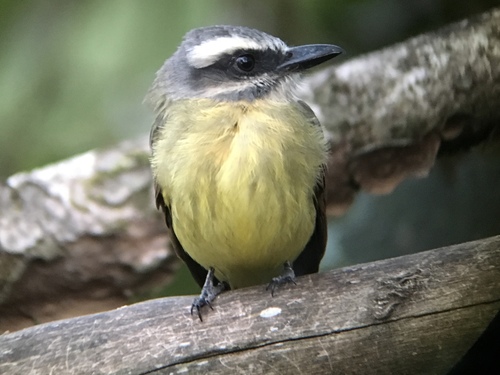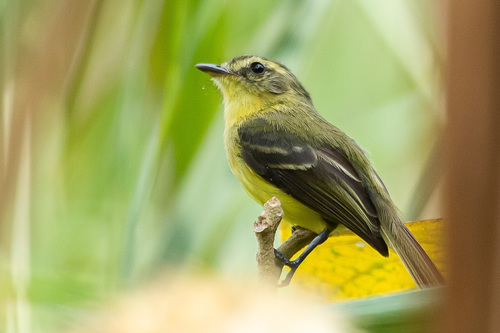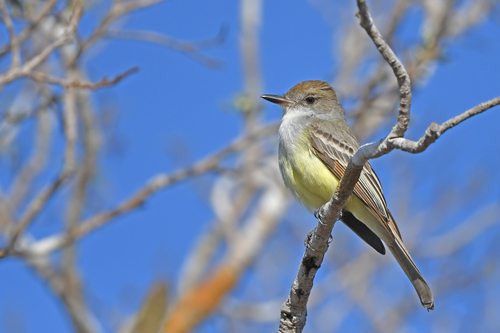
About Myiarchus swainsoni Cabanis & Heine, 1859
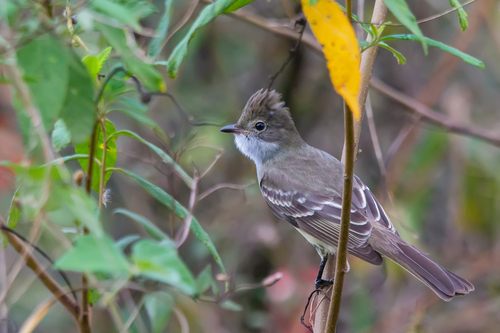
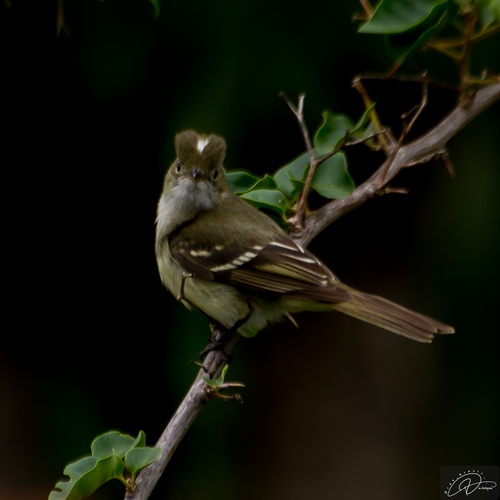
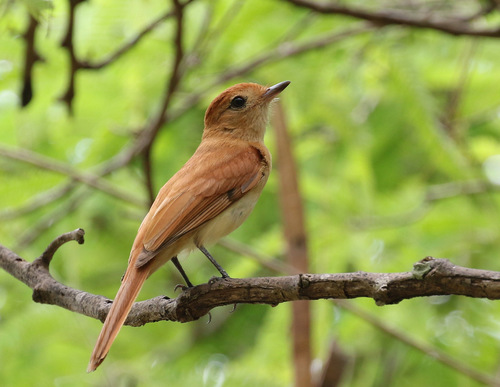
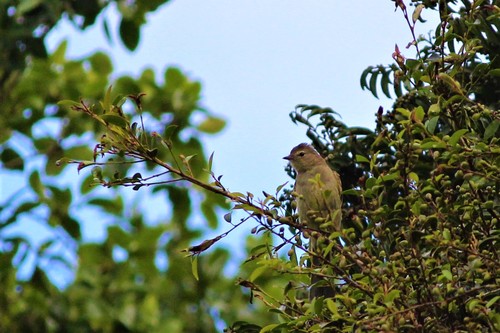
Swainson's flycatcher (Myiarchus swainsoni Cabanis & Heine, 1859) measures 19.5 to 21 cm (7.7 to 8.3 in) in length and weighs approximately 21 to 38 g (0.74 to 1.3 oz). Males and females have identical plumage. Adults of the nominate subspecies have a dull olive gray-green crown and upperparts, with slightly browner uppertail coverts. The crown feathers form a slight crest. Their wings are mostly brown, with rufous outer edges on the primaries. The secondaries and tertials have pale whitish yellow outermost webs, and the tertials have dirty white to rufous innermost webs. Their greater and median wing coverts have wide fuscous gray tips. Their tail is brown. Their throat and breast are gray, with the throat usually being paler. Their belly and undertail coverts are yellow with a gray tinge, and the upper flanks have a green wash. They have a dark iris, a brown maxilla, a pale rufous-brown to pinkish mandible, and blackish legs and feet. The subspecies M. s. phaeonotus has very dark smoky gray upperparts and a completely black bill. M. s. pelzelni has purer olive-green upperparts, and a slightly paler throat and underparts than the nominate subspecies. M. s. ferocior is the palest subspecies, but has a darker face than the nominate. Its upperparts are light olive-green, and its underparts are a purer, less gray yellow than the nominate's. Swainson's flycatcher is found across most of South America east of the Andes at some point during the year. Its overall range extends from western Venezuela south through eastern Colombia, eastern Ecuador, eastern Peru, northern and eastern Bolivia, and into Argentina as far south as the provinces of La Pampa and Buenos Aires. It extends east through Guyana into Suriname, and throughout Brazil, Paraguay, and Uruguay. Subspecies M. s. phaeonotus is a year-round resident in southern and eastern Venezuela, western Guyana, and northern Brazil in the upper watersheds of the Negro and Branco rivers. Subspecies M. s. pelzelni is a year-round resident in northern and eastern Bolivia, and extends east through Brazil between the Amazon Basin to the north and northern Mato Grosso do Sul, southern Goiás, and central Minas Gerais to the south. A small isolated population of M. s. pelzelni is resident year-round in Peru's northern Cuzco Department. The ranges of the other two subspecies are covered in the Movement section. While maps include French Guiana in the species' range, the South American Classification Committee of the American Ornithological Society has no confirmed records of the species from that country. The SACC does have records of vagrant individuals on Aruba and Trinidad. Swainson's flycatcher lives in a wide variety of landscapes, which sometimes differ between the breeding and non-breeding seasons. Most of its habitats are somewhat open, including forest clearings within large continuous forest, wooded cerrado and savanna, scrublands, and riparian zones. The nominate subspecies has been recorded in relatively small forest fragments, including some located within urban areas. It occurs in mangroves during the non-breeding season. In non-breeding season Venezuela, it is also found in várzea and terra firme forest. During the non-breeding season in Colombia and Ecuador, subspecies M. s. ferocior lives in shrubby clearings, river islands, and the edges of rivers and lakes. In Peru, it is found in the canopy and edges of rainforest. In terms of elevation, Swainson's flycatcher ranges from sea level to 1,800 m (5,900 ft) in Brazil. In Venezuela, resident birds reach 1,800 m (5,900 ft) on tepuis in the southeast, while migrants in western Venezuela are only found up to about 300 m (1,000 ft). It occurs below 500 m (1,600 ft) in Colombia, and mostly below 400 m (1,300 ft) in Ecuador. The small year-round population in Peru lives at around 1,000 m (3,300 ft), while migrants there reach only 600 m (2,000 ft).