About Myiarchus oberi Lawrence, 1877
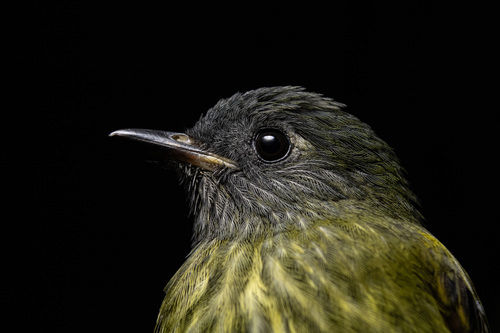
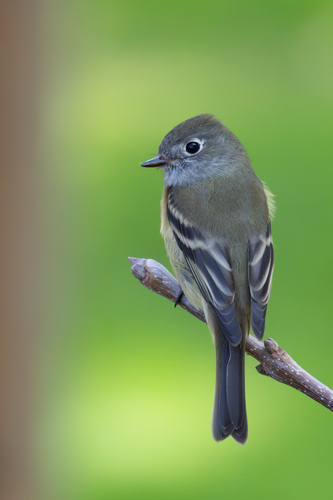
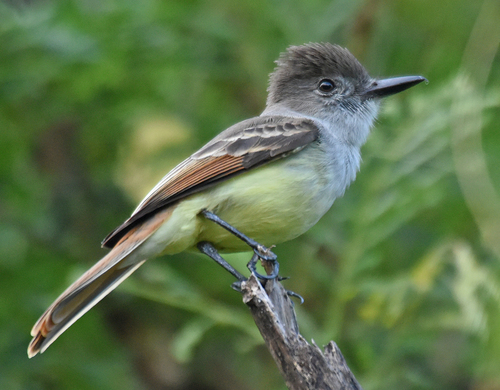
Myiarchus oberi Lawrence, 1877, commonly known as the Lesser Antillean flycatcher, measures 19 to 22 cm (7.5 to 8.7 in) in length and weighs 21 to 37 g (0.74 to 1.3 oz). The sexes have identical plumage. Adults of the nominate subspecies M. o. oberi have a dark olive-green crest-forming crown, with a grayer olive-green face. Most of their upperparts are dark olive-green, with rufous edges on the uppertail coverts. Their wings are mostly brown; the primaries have rufous outer edges, the tertials have rufous inner edges, and the outer edges of the tertials and secondaries are a paler rufous. The greater and median wing coverts have grayish white or rufous tips that form two faint wing bars. Their tail is mostly dark olive-green, with a wide rufous stripe running along the inner vanes of the tail feathers. Their throat and breast are gray, with the throat being paler than the breast. Their belly and undertail coverts are yellow, with a greenish wash on the flanks. Among the four recognized subspecies, M. o. sclateri is the smallest and has no rufous coloring on its tail. M. o. sanctaeluciae is the largest subspecies, and is otherwise identical in appearance to the nominate subspecies. M. o. berlepschii is intermediate in size between M. o. sanctaeluciae and the nominate subspecies, and its belly is often a paler yellow than that of the nominate. All subspecies have a dark iris, a dark bill, and dark legs and feet. Each subspecies has a distinct distribution in the Lesser Antilles: the nominate M. o. oberi occurs on Guadeloupe and Dominica, M. o. sanctaeluciae occurs on St. Lucia, M. o. berlepschii occurs on St. Kitts, Nevis, and Barbuda, and M. o. sclateri occurs on Martinique. The species primarily inhabits the canopy and edges of tropical evergreen forest, tree plantations, and thorn scrub. It occurs much less often in secondary forest. Most of its range falls between 100 and 900 m (300 and 3,000 ft) in elevation, and it is almost never found at lower elevations.