About Myiarchus magnirostris (Gould, 1839)
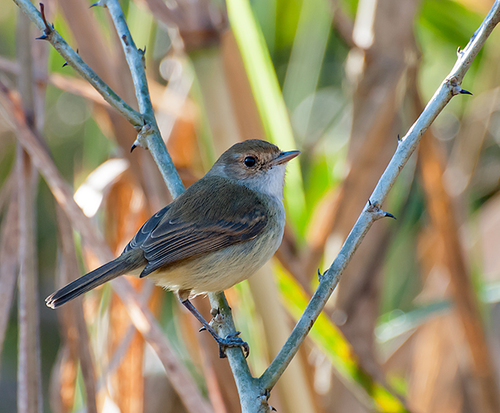
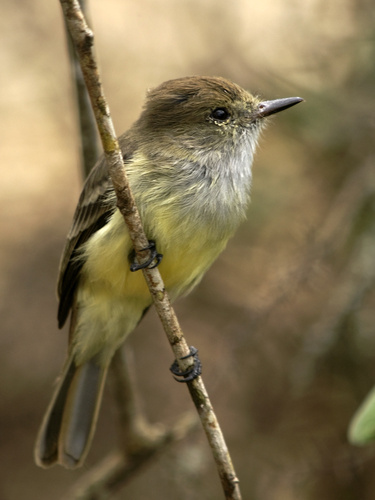
The Galapagos flycatcher, Myiarchus magnirostris (Gould, 1839), is 14 to 16 cm (5.5 to 6.3 in) long and weighs 12 to 18.5 g (0.42 to 0.65 oz). Males and females have identical plumage. Adults have a gray-brown to olive-brown crown, with feathers that form a small crest. The rest of the face is a lighter gray-brown. Most of the upperparts are gray-brown to olive-brown, with a brown rump. The wings are mostly olive-brown to brown; the primaries and secondaries have paler edges, and the wing coverts have paler tips that form two distinct wing bars. The tail is gray-brown, with rufescent edges along the tail feathers. The throat and upper breast are gray, while the lower breast and belly are sulphur-yellow. The species has a dark iris, a thick dark brown to black bill with a pinkish base to the lower mandible, and gray legs and feet. The Galapagos flycatcher occurs on all Galápagos Islands except Darwin, Wolf, and Genovesa, though there is a single historical record from each of these three islands dating to the late nineteenth or early twentieth century. It inhabits every vegetated habitat type across the islands. Its range extends from sea level up to at least 1,000 m (3,300 ft), and it is more abundant in moister lowland areas.