About Myiarchus ferox (Gmelin, 1789)
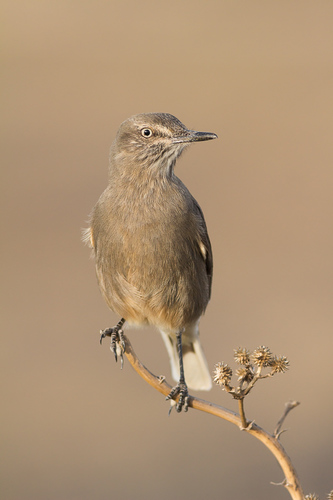
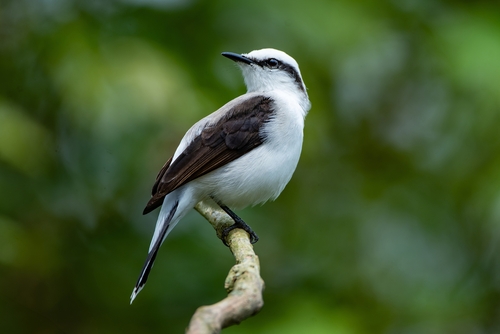
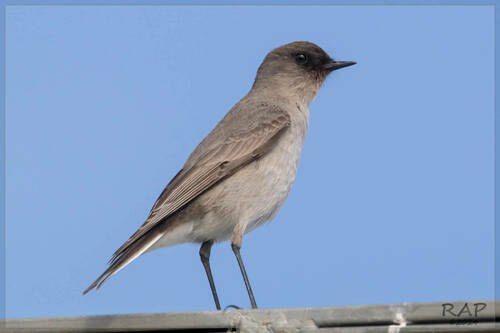
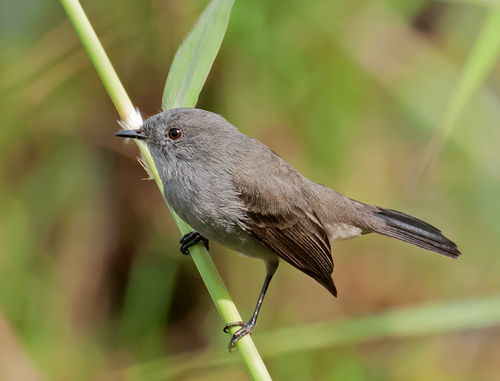
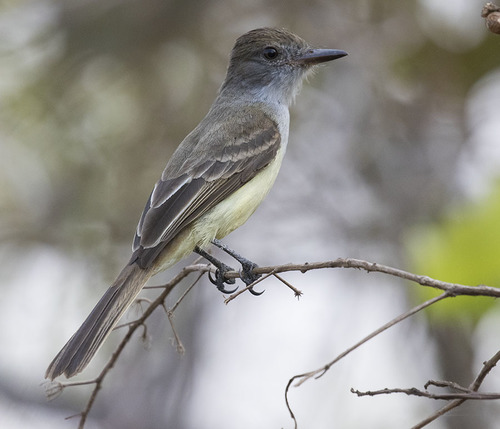
The short-crested flycatcher (Myiarchus ferox) is approximately 18 cm (7.1 in) long and weighs 21 to 34 g (0.74 to 1.2 oz). Both sexes share identical plumage. Adults of the nominate subspecies, M. f. ferox, have smoky brown crowns and upperparts, with a small crest on the crown. The rest of their face is gray. Most of their wings are dark brown; the outer webs of the tertials range in color from whitish yellow to grayish. The greater and median coverts of the wing have wide paler fuscous brown tips that form two distinct wing bars. Their tail is dark smoky brown, with rufous edges on the feathers that wear away quickly. Their throat and breast are gray, with the throat being slightly lighter than the breast. Their belly and undertail coverts are yellow. Subspecies M. f. brunnescens has lighter brown upperparts than the nominate subspecies, wider rufous edges on its tail feathers, and an olive-green wash on its flanks. M. f. australis is similar to brunnescens, but has a less brown crissum. All subspecies have a dark iris, dark bill, and dark legs and feet. Juveniles have rufous tips on their wing coverts, and rufous edges on their tertials and outermost pair of tail feathers.
The short-crested flycatcher has three subspecies with different distribution ranges. The nominate subspecies has the largest range. It occurs in the Amazon Basin, from southern Colombia south through eastern Ecuador and eastern Peru to northern Bolivia, and east through southern and eastern Venezuela, the Guianas, and Brazil north of an approximate line running through southern Mato Grosso, southern Goiás, southern Minas Gerais, and central Espírito Santo. Subspecies M. f. australis is found from southeastern Bolivia east across Brazil below the line noted above, with a large amount of range overlap with the nominate subspecies, and extends south through Paraguay and Brazil almost to Rio Grande do Sul, into the Misiones and Corrientes provinces of northern Argentina, and slightly into northern Uruguay. M. f. brunnescens has a restricted range in the Llanos of extreme northeastern Colombia, extending into Venezuela from Táchira and Portuguesa east to northwestern Bolívar.
This species lives in a variety of mostly somewhat open landscapes, including dense forest clearings and edges, várzea and igapó forest, cerrado, riparian corridors, and agricultural areas. Its maximum elevation range differs by country: it occurs up to 900 m (3,000 ft) in Colombia, 1,000 m (3,300 ft) in Ecuador, 1,100 m (3,600 ft) in Peru, 500 m (1,600 ft) north of the Orinoco River in Venezuela, and 1,000 m (3,300 ft) south of the Orinoco River in Venezuela.