About Myiarchus crinitus (Linnaeus, 1758)
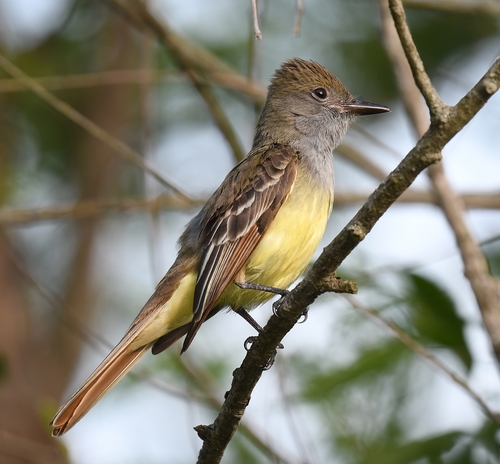
Adult great crested flycatchers (Myiarchus crinitus) typically measure 17–21 cm (6.7–8.3 in) in length, have a wingspan of around 34 cm (13 in), and weigh between 27–40 g (0.95–1.41 oz). This species shows no sexual dimorphism. All adults have brownish upperparts, yellow underparts, a long rusty brown tail, a bushy crest, and grey throat and breast. Males produce a three-part "dawn song" (also called twilight song), made up of two short whistles: a wheerreep followed by a higher-pitched whee, ending with a soft low churr. This short-distance song is intended for potential mates, and is associated with periods of low disturbance and stress; it typically becomes most intense just before dawn. In addition to the dawn song, great crested flycatchers make a range of other calls. A series of fast ascending huit, huit, huit is given when the birds are stressed or excited during interactions between neighbors. The species' most characteristic sound is a single loud whee-eep, used for communication between mates, or between parents and young. Faster repetition of this call usually signals that a predator is near nests and young. A rapid sequence of harsh rasps signals alarm or stress, and is often heard during territorial disputes between neighboring birds. Great crested flycatcher habitat selection varies slightly between populations, but the species is most often found breeding in deciduous forests, along the edges of clearings, and in mixed woodlands. They tend to favor open-canopy landscapes such as second-growth forests or woodlands that have undergone selective cutting, and avoid habitats dominated by conifers, such as the Canadian boreal forest. The species' summer breeding range covers all of eastern and mid-eastern United States, plus parts of central United States including northern and southern Florida, parts of Texas, central Oklahoma, and eastern and central North Dakota. In Canada, breeding great crested flycatchers are restricted to southern Manitoba, extreme southern portions of the St-Lawrence forest of Ontario, Quebec, northeast Nova Scotia, and parts of Prince Edward Island. The species' winter range includes most of southern Mexico, the Yucatán Peninsula, and extends along the coasts of Central America. Great crested flycatchers can be found year-round in southern peninsular Florida, and migrate to Mexico, South America, Florida, and the Caribbean for the non-breeding season. The great crested flycatcher is primarily an insectivore, with insects and other invertebrates making up the majority of its diet, but it also consumes a small portion of small fruits and berries. Despite being called a "flycatcher", flies and spiders only make up a small percentage of the species' diet. Great crested flycatchers prefer prey such as butterflies, moths, beetles, grasshoppers, crickets, bees, and wasps. They use a variety of hunting tactics, but the most commonly observed method is the passive sit-and-wait strategy. They perch in high canopies, search in all directions, and often bob their head while searching. Once they spot potential prey, they swoop down, and will pursue prey if they miss on the first dive. They may also stop abruptly and hover to pick insects or small fruits from leaves, trunks, or other surfaces, sometimes crashing into foliage in the process. When they consume fruits and berries, they swallow them whole and later regurgitate the pits.