About Myiarchus cephalotes Taczanowski, 1880
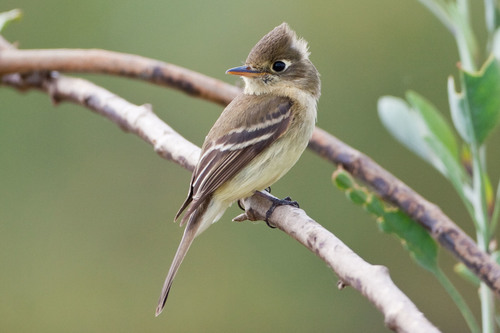
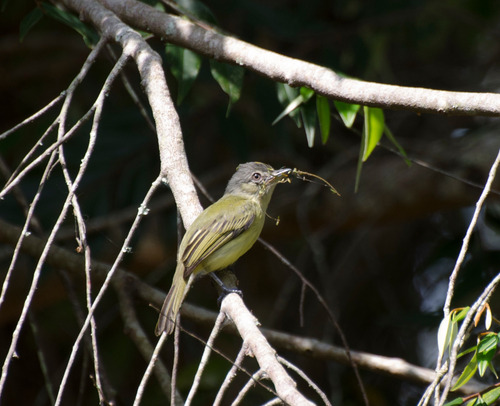
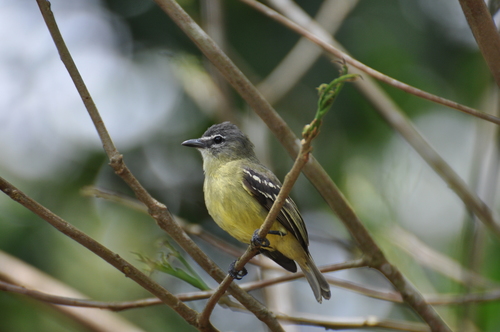
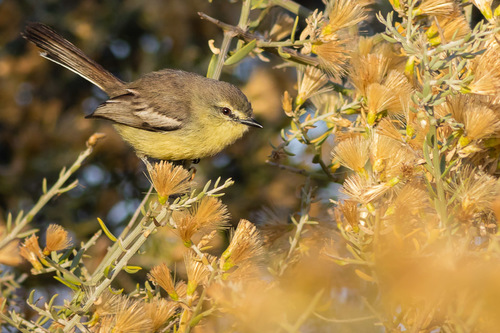
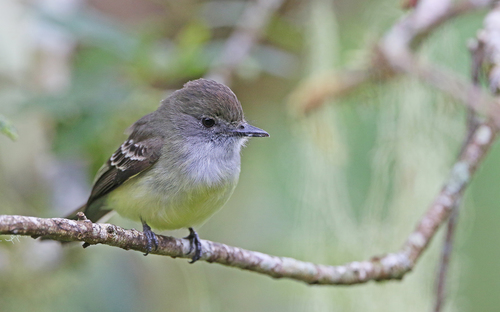
Pale-edged flycatcher, Myiarchus cephalotes Taczanowski, 1880, measures 18 to 19 cm (7.1 to 7.5 in) in length and weighs approximately 22 to 31 g (0.78 to 1.1 oz). Males and females have identical plumage. Adult individuals of the nominate subspecies have a brownish olive crown, which bears a slight crest. Slightly darker feather centers on the crown create a streaked appearance. The rest of the face is pale gray. Upperparts are olive-green. Wings are mostly brownish olive, with pale whitish to yellow outer edges on the secondaries and tertials. The greater and median wing coverts have yellowish outer edges and tips; the median coverts form two distinct wing bars. The tail is brownish olive, with whitish outer webs on the outermost tail feathers. This pattern is unique to this species within the genus Myiarchus, and it is the source of the species' English common name. The throat and breast are gray, with the throat being slightly paler than the breast. The belly and undertail coverts are yellow, with a richer yellow tone in the center of the belly. The subspecies M. c. caribbaeus is smaller than the nominate subspecies, and has even paler outer webs on its tail feathers. Both subspecies have a dark iris, a dark bill, and dark legs and feet. Juveniles have rufous edges on their wing coverts and tail feathers. The nominate subspecies has a much larger range than M. c. caribbaeus. It occurs across all three ranges of the Colombian Andes, and extends south along the eastern Andean slope through Ecuador and Peru into Bolivia, reaching as far as western Santa Cruz Department. Subspecies M. c. caribbaeus is found only in Venezuela, where it has four separate populations. From west to east, these populations are located in the Andes of Trujillo and Lara states; in the Venezuelan Coastal Range in Aragua, the Federal District, and likely northern Monagas; in the mountains along the Guárico-Aragua border; and in the mountains of Sucre. Pale-edged flycatcher lives in partially open landscapes within the subtropical and lower temperate zones. These habitats include edges and clearings of moist and humid forest, as well as open woodlands. Its elevation range varies by location: between 1,400 and 2,100 m (4,600 and 6,900 ft) overall, and is probably lower in Venezuela; between 1,500 and 2,500 m (4,900 and 8,200 ft) in Colombia; mostly between 1,000 and 2,200 m (3,300 and 7,200 ft) in Ecuador; and between 1,100 and 2,600 m (3,600 and 8,500 ft) in Peru.