About Myiarchus antillarum (H.Bryant, 1866)
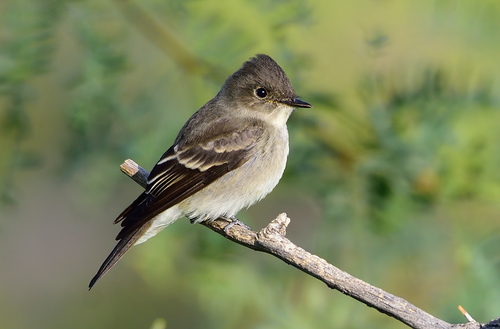
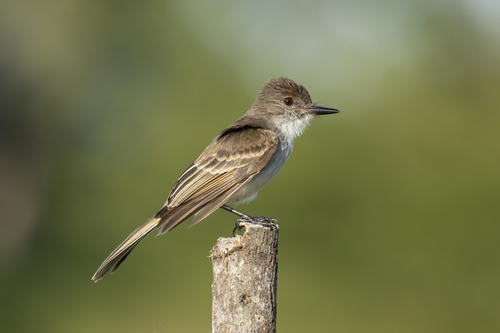
The Puerto Rican flycatcher (scientific name Myiarchus antillarum (H.Bryant, 1866)) measures approximately 16 to 18 cm (6.3 to 7.1 in) in length, and weighs between 20.5 and 27.5 g (0.72 to 0.97 oz). Both sexes share identical plumage. Adult individuals have a dark sooty brown crest formed by the crown of the head, and a lighter sooty brown face. Their upperparts are colored olive-brown. Their wings are mostly olive-brown, with cinnamon-buff edges along the inner webs of the flight feathers. Their tail is mostly dusky with pale feather tips. The outer tail feathers have pale grayish brown outer webs, while all tail feathers between the outer pair and the innermost pair have rufous-cinnamon inner webs. Their throat and breast are pale gray, with an olive-brown tinge on the sides of the breast. Their belly and undertail coverts are white, and the flanks and undertail coverts usually carry a faint yellow tinge. This species has a brown iris, a brownish black bill with a brownish base to the lower mandible, and brownish black or blackish brown legs and feet. The Puerto Rican flycatcher is distributed across Puerto Rico (including the islands of Vieques and Culebra), the islands of St. John and St. Thomas in the American Virgin Islands, and the islands of Tortola and Virgin Gorda in the British Virgin Islands. It lives in deciduous forest, pine forest, mangroves, coffee plantations, and arid scrublands, and occurs in the tropical zone between sea level and 800 m (2,600 ft) in elevation.