About Mycena vitilis (Fr.) Quél.
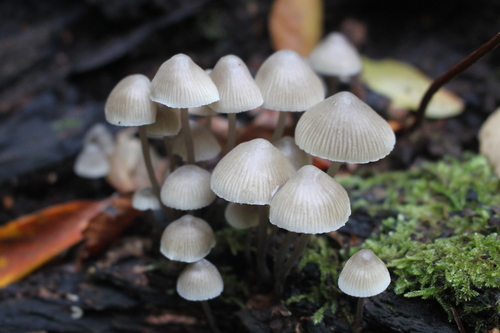
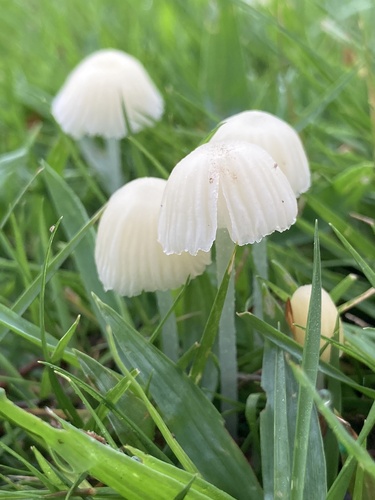
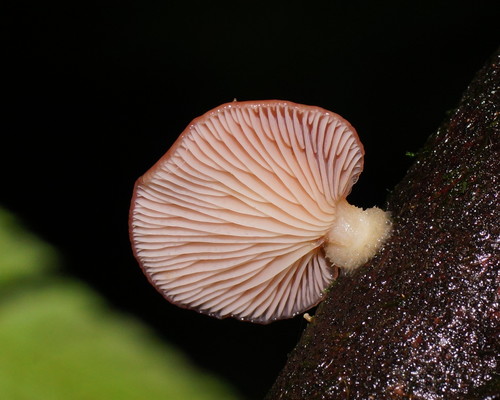
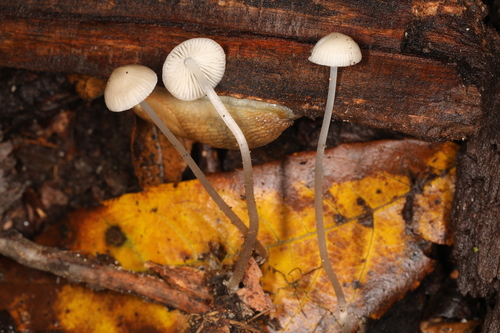
The scientific name of this mushroom is Mycena vitilis (Fr.) Quél. The cap of M. vitilis starts out conic or bell-shaped, and flattens as it matures, typically growing up to 2.2 cm (0.9 in) across. When young, the cap margin is pressed against the stem; as the cap expands, the cap becomes bell-shaped or somewhat umbonate, and the margin flattens out or curves inward. The cap surface is hoary when young, but soon becomes polished and slimy when moist, or shiny when dry. Faint grooves on the cap margin mark the position of the gills underneath the cap. The cap is beige, sometimes with a grayish tint, and has paler margins; it fades to pale gray or nearly white as it ages. Occasionally, fresh mushroom caps have a strong brownish tint. Moist caps have a slightly sticky surface. The flesh is thin but pliant, grayish or pallid, and cartilaginous, with no distinctive odor or taste. The gills attach to the stem via a small tooth, are narrowly adnate, range from close to subdistant in spacing, are narrow and uniform in size, and are white or grayish, with edges the same color as the gill face and often slightly eroded. Berkeley noted that the gills of this species "vary a good deal in colour, and are sometimes very dark". The stem of M. vitilis measures 6–12 cm (2.4–4.7 in) long and 1.5–2 mm (0.06–0.08 in) thick, is uniform in width along its length, and is cartilaginous and tough. The stem is brown with a pink tint, and its color lightens toward the top. It is usually straight but often curves toward its base, growing into woody debris or attaching to sticks. Smith observed that "robust" forms with a "strict and rigid" appearance can be found when weather conditions are optimal. The buried portion of the stem is covered with thick, stiff whitish hairs, and is surrounded by a thin subgelatinous layer that makes it slimy to the touch. The stem is initially bluish-black, quickly turning gray to match the color of the cap, and the apex is somewhat fibrous-striate. This mushroom is classified as inedible. For microscopic characteristics, the spores of M. vitilis are ellipsoid, hyaline, and amyloid, and measure 9–11 by 5–6 μm. The spore-bearing basidia are four-spored. Pleurocystidia (cystidia on the gill face) are either not differentiated or occasionally present near the gill edge, where they resemble cheilocystidia (cystidia on the gill edge). Cheilocystidia measure 32–46 by 8–14 μm, are tapered at both ends, and may have two to several obtuse fingerlike projections growing from their apex. Gill tissue stains vinaceous-brown when exposed to iodine. The subhymenium, the tissue layer directly beneath the hymenium, is made of narrow, interwoven hyphae; the central portion of the gill is composed of long, cylindrical, moderately broad cells. The cap flesh has a fairly thick subgelatinous pellicle, a well-differentiated hypoderm, and a filamentous tramal body. All cap tissues except the pellicle stain vinaceous-brown in iodine. Fruit bodies of Mycena vitilis grow scattered or in groups on debris in hardwood forests, or mixed conifer and hardwood forests. Along the Pacific Coast, it is sometimes abundant in red alder slashes. In eastern North America, it is quite commonly found growing in the autumn months of October and November, alongside M. semivestipes and M. pullata. The fungus is widely distributed across Europe, with recorded occurrences in Britain, Germany, Italy, Norway, Poland, and Portugal.