About Mycena subviscosa G.Stev.
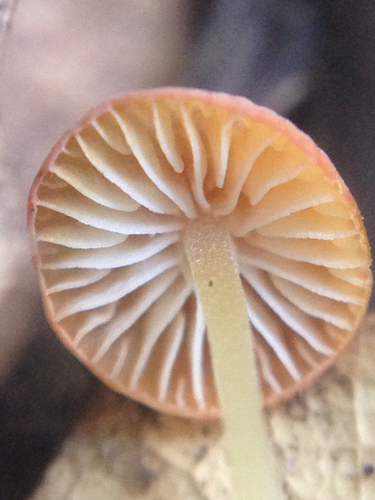
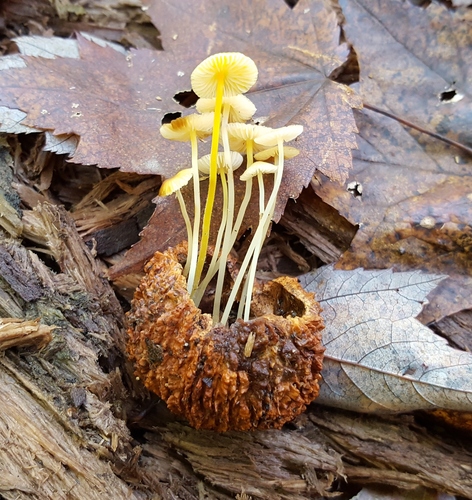
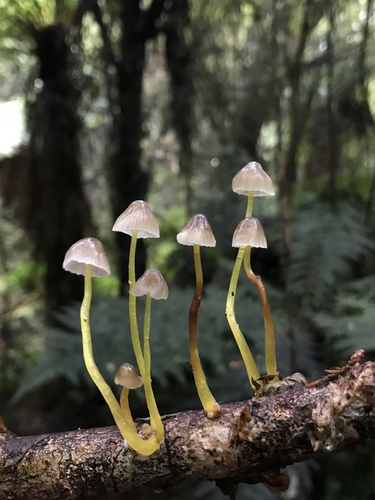
Mycena subviscosa G.Stev. has a pileus (cap) 5–10 mm in diameter, with a striate margin. The cap is hemispherical in shape, viscid, and dries to a subfibrillose texture; its color is pale greyish fawn. The flesh is thin, white, and fragile. The gills are whitish, moderately crowded, with a mix of interspersed long and short gills, and have gelatinised margins. Gill attachment to the stipe ranges from adnate to strongly decurrent. The stipe is fragile and hollow, measuring 30–60 mm long and 1–2 mm wide. It is yellow in color, very viscid, swollen at the base, and usually has spreading hyphal hairs. Spores are amyloid, meaning they turn blue-black when stained with iodine, a reaction that indicates the presence of starch. The hymenophoral trama and the tissue of the pileus are pseudoamyloid. The cuticle is somewhat gelatinised, with narrow, non-amyloid branched hyphal endings. Mycena subviscosa is distributed across most areas of New Zealand's North Island, excluding Gisborne. In the South Island, most sightings are in the northern regions of the West Coast, with additional observations around Southland and Dunedin. This species grows singly or in groups on standing or fallen timber.