About Mycena stylobates (Pers.) P.Kumm.
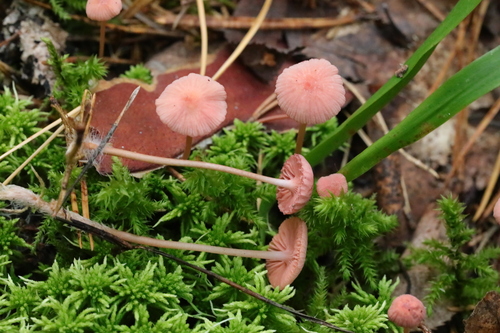
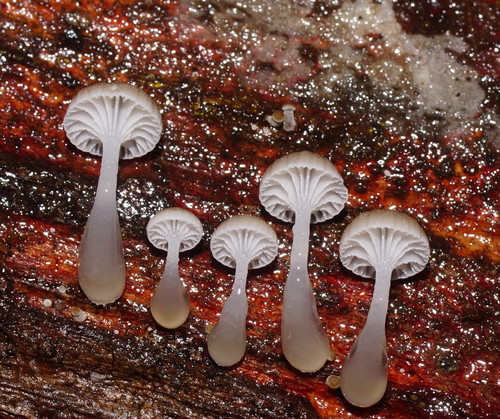
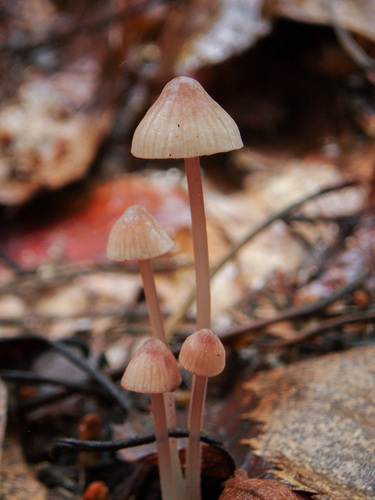
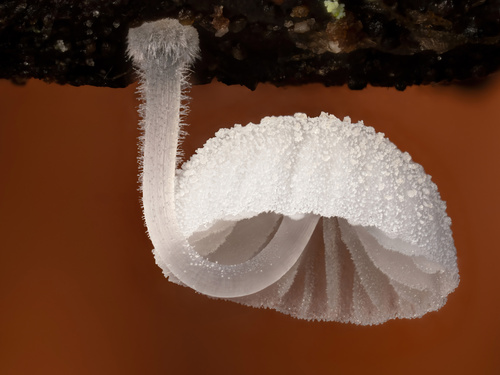
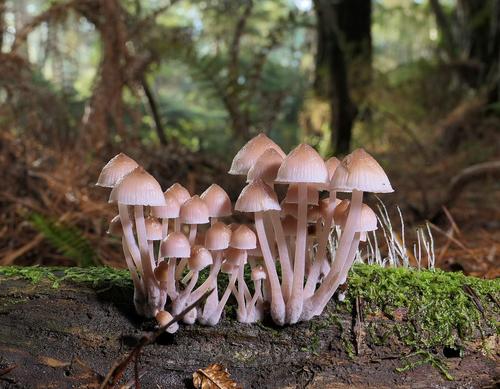
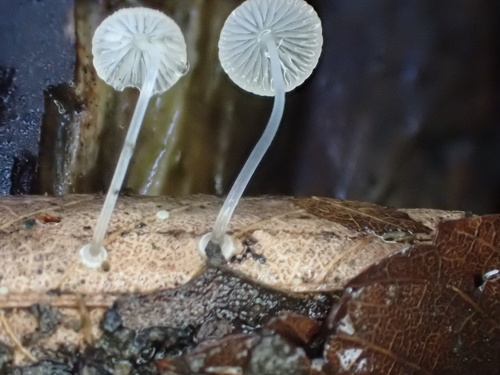
Mycena stylobates (Pers.) P.Kumm. has caps that measure 3–15 mm (0.1–0.6 in) in diameter. Cap shape changes with age, ranging from obtusely conic, to convex, to bell-shaped, and finally to flattened. The cap margin also changes with age, starting straight or slightly curved inward, and progressing to flaring or curved backward. The cap surface is smooth, though minute spines are visible when viewed with magnification; as the mushroom ages, the surface becomes fully smooth, moist and somewhat glistening, and develops grooves that line up with the position of the gills underneath the cap. The entire cap is an even pale watery gray. The flesh is thin, pallid, and has no distinct odor or taste. Gills are closely spaced in unexpanded young caps, but become more widely spaced in older individuals. Between 8 and 16 full gills reach from the cap margin to the stipe, with an additional one or two tiers of shorter, smaller gills (lamellulae) that do not extend all the way from the margin to the stipe. The gills are narrow when young, become ventricose (swollen in the middle) and sometimes very broad as they age, and attach to the stipe via a line or are very narrowly adnate. Sometimes gills split away from the stipe while remaining connected to each other, forming a collar around the stipe. Gills are pale gray when young, quickly turning whitish, and have even edges. The stipe is 10–60 mm (0.4–2.4 in) long and 0.5–1 mm thick; above the flat circular basal disc, it is equal in width along its entire length. The stipe is covered with fine, scattered white fibrils, or is delicately pruinose (appearing coated in a fine white powder), and becomes smooth with age. When fresh, the stipe is bluish-gray, but quickly fades to plain gray. The basal disc has grooves from gill impressions, is pruinose or covered in fine minute hairs, and also becomes smooth with age. The insubstantial fruit bodies of this species are classified as inedible.
In terms of microscopic characteristics, the spores are 6–10 by 3.5–4.5 μm, narrowly ellipsoid, and faintly amyloid. The spore-bearing basidia are almost always four-spored, and rarely two-spored. Pleurocystidia (cystidia on the gill face) are not differentiated. Cheilocystidia (cystidia on the gill edge) are abundant and structurally variable; they are usually club-shaped with between two and five thick, blunt projections emerging from near the apex, and sometimes are more or less covered in numerous protuberances over the enlarged portion, with a neck that is more or less contorted. Cheilocystidia measure 26–38 by 8–13 μm, and are hyaline. The gill flesh is composed of greatly enlarged cells, and stains pale vinaceous (red wine color) when exposed to iodine. The cap flesh has a pellicle (outer surface layer) that usually gelatinizes when prepared in potassium hydroxide or water mounts for microscopy. The surface hyphae are covered with short rodlike projections. Some hyphae sometimes aggregate into peglike structures that project from the cap surface, creating the appearance of scattered coarse spines when viewed under a 10X magnifying lens. The tissue under the pellicle is made entirely of greatly enlarged cells, which stain pale vinaceous in iodine. When grown in pure culture, the mycelia of M. stylobates are bioluminescent, a property first reported in 1931. Fruit bodies are not known to be bioluminescent.
For habitat and distribution, the fruit bodies of Mycena stylobates grow scattered or in groups on oak leaves or coniferous needles, and fruit in spring, summer, or early autumn. It is common during warm, wet seasons. Mycena specialist Alexander H. Smith collected this species in Tennessee, Michigan, Idaho, and Washington in the United States, and in Nova Scotia and Ontario in Canada. It is also found across Europe, including Britain, Denmark, Germany, Norway, Poland, Romania, Scotland, Serbia, and Sweden. While it has been reported multiple times from Australia, mycologist Cheryl Grgurinovic concluded in a 2003 publication that these records are best regarded as erroneous.