About Mycena sanguinolenta (Alb. & Schwein.) P.Kumm.
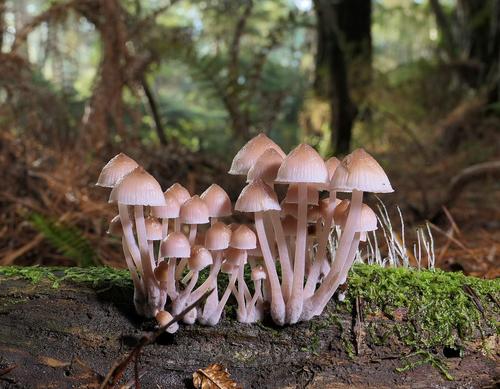
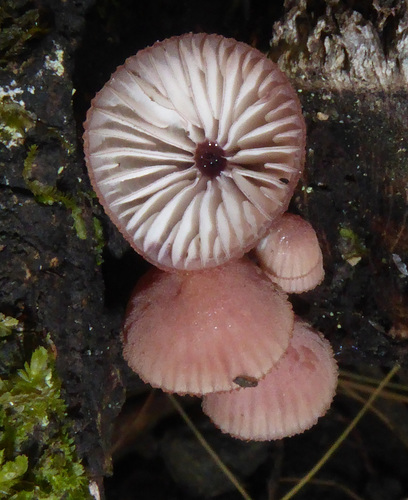
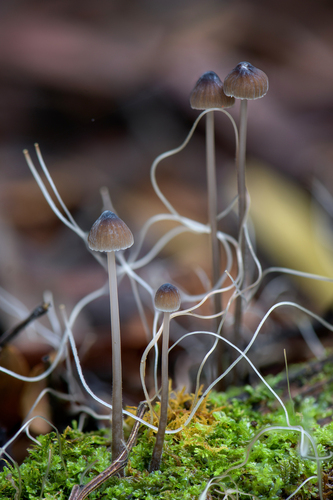
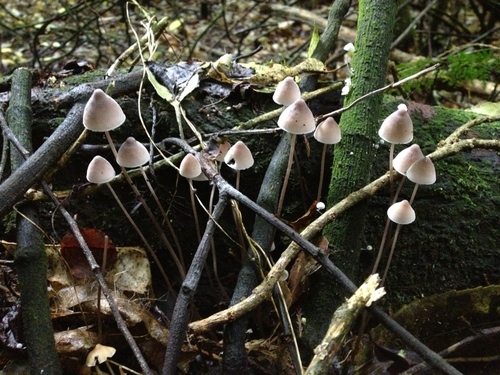
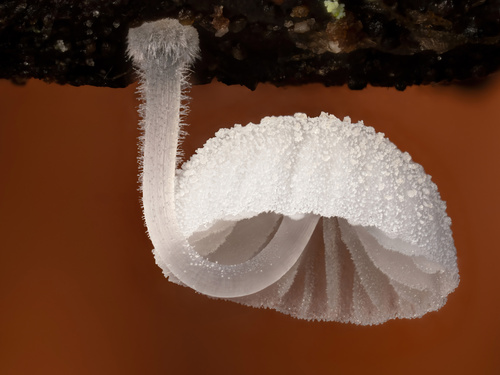
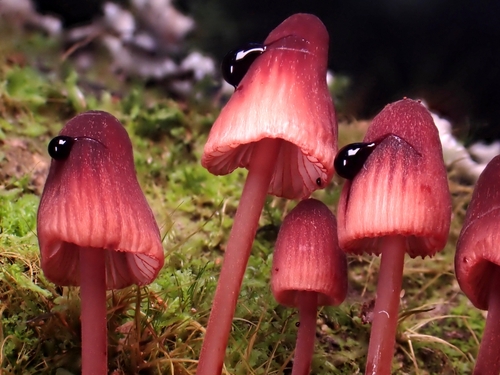
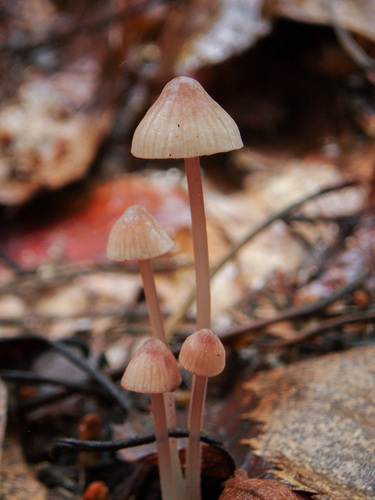
Mycena sanguinolenta (Alb. & Schwein.) P.Kumm. has a cap that starts out convex or conic when young, with its margin pressed against the stipe. As the cap expands, it becomes broadly convex or bell-shaped, and finally reaches a diameter of 3–15 mm (0.1–0.6 in). When young, the cap surface is covered in a dense whitish-grayish coating or powder formed by delicate microscopic cells. These cells quickly collapse and disappear, leaving the surface bare and smooth. The surface is moist, with an opaque margin that soon develops furrows. Cap color varies, but is always some shade of bright or dull reddish brown, with a dull grayish-brown margin. The flesh is thin, not very fragile, and dirty reddish in color, and oozes reddish latex when cut. It has no distinctive odor or taste. The gills are adnate or slightly toothed, and well-spaced. They are narrow to moderately broad, ranging from dirty reddish to grayish, with even edges that are dark reddish brown. The stipe is 2–6 cm (0.8–2.4 in) long, 1–1.5 mm thick, stays the same width along its length, and is fragile. The base of the stipe is covered in coarse, stiff white hairs, while the rest of the stipe is covered in a drab powder that sloughs off quickly, leaving the stipe polished and roughly the same color as the cap. The stipe also oozes bright or dull red juice when cut or broken. The edibility of this mushroom is unknown, but it is considered too small and insubstantial to be of culinary interest. The spores measure 8–10 by 4–5 μm, are roughly ellipsoid, and are only weakly amyloid. The spore-bearing basidia are four-spored, though they are occasionally two- or three-spored. Pleurocystidia (cystidia on the gill face) range from rare to scattered, and are sometimes quite abundant; they are narrowly to broadly ventricose, measuring 36–54 by 8–13 μm, and are filled with a dirty reddish substance. Cheilocystidia (cystidia on the gill edge) are either similar to pleurocystidia or shorter and broader, and are very abundant. The gill flesh is made of broad hyphae, whose cells are often vesiculose (covered with vesicles) when mature, and stain pale reddish brown in iodine. The cap flesh is covered with a thin pellicle, and the hypoderm (the cell layer immediately under the pellicle) is moderately well-differentiated. The rest of the cap flesh is floccose and filamentous, and all parts except the pellicle stain pale vinaceous-brown in iodine. Lactiferous (latex-producing) hyphae are abundant. Mycena sanguinolenta is common and widely distributed. In the United States, it has been found from Maine to Washington, and south to North Carolina and California. In Canada, it occurs from Nova Scotia to British Columbia. It has been collected in Jamaica at an elevation of 1,800 m (5,900 ft). Its distribution also includes Europe (Britain, Germany, The Netherlands, Norway, Romania and Sweden) and Australia. In Asia, it has been collected from the alpine zone of the Changbai Mountains in Jilin Province, China, and from the provinces of Ōmi and Yamashiro in Japan. Fruit bodies grow in groups on leaf mold, moss beds, or needle carpets during spring and fall. It is common in fir and beech forests, and prefers to grow in highly acidic soil.