About Mycena purpureofusca (Peck) Sacc.
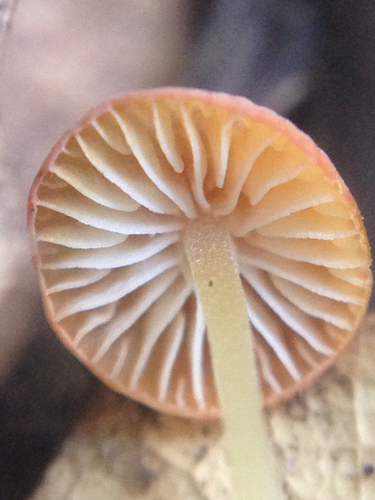
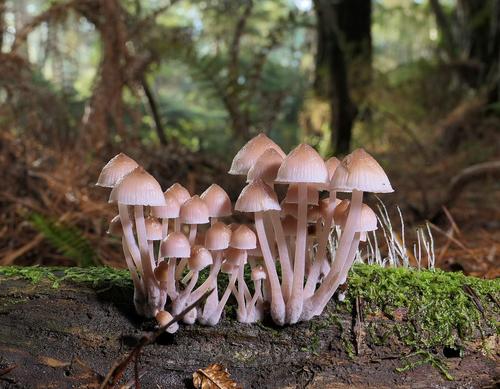
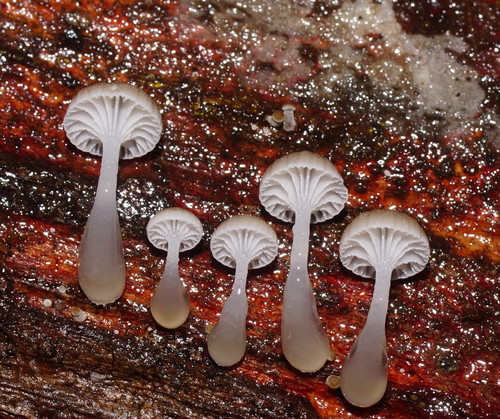
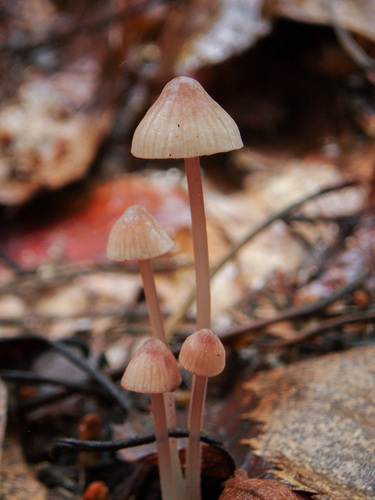
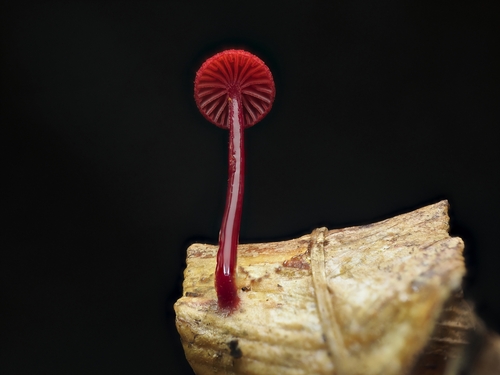
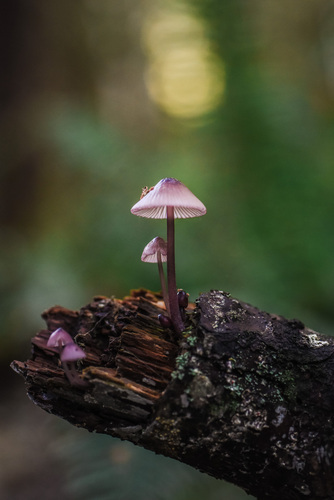
Mycena purpureofusca (Peck) Sacc. has a cap that ranges from conical to bell-shaped, flattening as it ages, with a diameter of 0.5–2.5 cm (0.2–1.0 in). The cap margin typically curves inward when young. The cap surface is covered in tiny white hairs initially, becoming smooth over time. The cap is slightly hygrophanous: when moist, it is slightly translucent, allowing the outline of the underlying gills to show through. The cap is dark purple at its center, fading to pale lilac at the margins; older specimens are purplish-gray. The flesh is thin, pliant, and has a cartilage-like texture. It starts as purplish-gray, fading to pale lilac or white in older specimens. The mushroom has a mild odor and an unremarkable, indistinct taste. The narrow gills attach ascending to the stipe in a narrowly adnate arrangement. They are spaced somewhat closely, with pallid to grayish faces and dark grayish purple edges that are sometimes fringed. The tubular stipe is 3–10 cm (1.2–3.9 in) long and 1–3 mm thick. It is tough and cartilaginous, with its base covered in white hairs. The stipe overall matches the cap’s color or is paler, and is often paler near its top. Spores are broadly ellipsoid and amyloid, with differing dimensions based on whether they come from four-spored or two-spored basidia (spore-bearing cells): four-spored basidia produce spores 8–10 by 6–7 μm, while two-spored basidia produce spores 10–14 by 6.7–8.5 μm. Abundant cheilocystidia grow on the gill edges. These cystidia measure 30–50 by 7–12 μm, are fusoid-ventricose with broadly rounded tips, and are filled with purplish sap and granular contents. Cap tissue is made up of a well-differentiated cuticle, a distinct hypoderm, and a filamentous tramal body. Clamp connections in the hyphae are rare or absent. Fruit bodies grow singly or in clusters on decaying conifer wood, especially spruce, pine, and Douglas-fir. They are also commonly found growing on decaying pine cones. A European study found the fungus growing on logs ranging from mostly hard decay with most bark still intact, to fully decayed wood that was soft throughout. In North America, it has been recorded in the U.S. states of North Carolina, Tennessee, New York, Michigan, Montana, Idaho, Washington, Oregon, California, Virginia, and South Dakota, and in the Canadian province of Ontario. Smith noted that collections from Michigan are most often found on old hemlock knots lying in soil, where it usually fruits singly; it more often grows in clusters on logs and stumps. In Europe, it has been recorded from Britain, Scotland, the Czech Republic, Poland, Germany, Turkey, and Austria. In the UK, it is commonly found in Caledonian pine woods, and is considered an indicator species for this habitat type.