About Mycena polygramma (Bull.) Gray
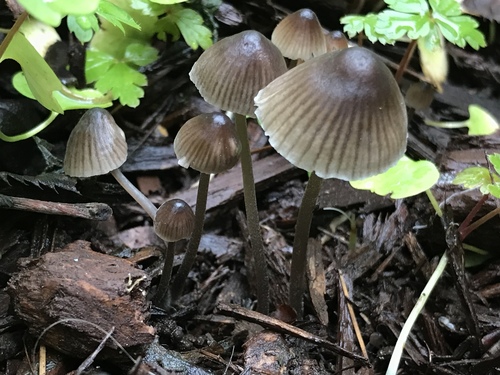
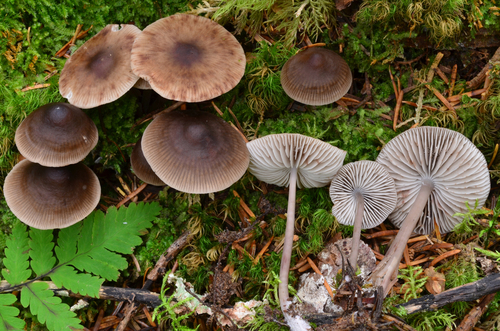
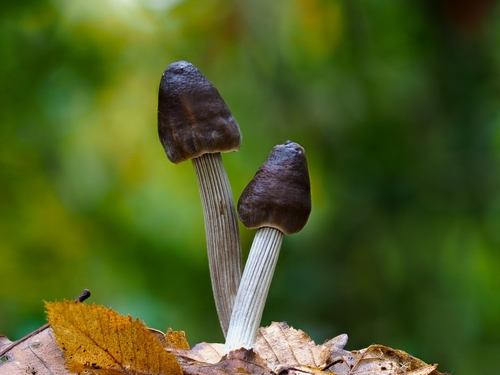
The fruit body cap of Mycena polygramma measures 2 to 4 cm (0.8 to 1.6 in) in diameter. It starts out egg- to cone-shaped, and expands to become conic to bell-shaped, nearly convex with an abrupt small umbo, or occasionally flat with a conic umbo. On young fruit bodies, the cap margin curves slightly inward and often has scalloped edges; when mature, the margin flares out or curves backward and becomes wavy. The cap surface is initially covered in short, fine whitish or grayish hairs that often remain until close to maturity. As the cap ages, its surface becomes smooth. Under a fine powdery bloom, the cap color ranges from dark brownish gray to black, fades slowly to pale gray, and may sometimes turn nearly pinkish-buff. The cap margin is opaque, and often bears narrow, deep furrows or grooves; the cap surface is more or less uneven, and often appears streaked with glistening lines. The flesh is very hard and cartilaginous, watery grayish to white, rather thin, with no distinctive odor and a mild taste. The gills are narrowly adnate (attached squarely to the stem) or have a short decurrent tooth, and are closely packed. 30–38 gills reach the stem; they are broad at the front (4–7 mm), white or whitish, and develop a pink flush as they age. They often have sordid-brownish stains, with pale, even edges. The stem is 6 to 15 cm (2.4 to 5.9 in) long, 0.2 to 0.5 cm (0.1 to 0.2 in) thick, very brittle and cartilaginous, uniform in width along its length, and hollow. It sometimes has a well-developed pseudorrhiza that looks like white cotton. The base is covered with stiff white hairs, and often stains reddish brown. The stem surface has fine straight or sometimes twisted longitudinal striations. Under a silvery outer covering, the surface is ashy-gray or paler grayish brown, occasionally nearly smooth; the apex of the stem is pale and faintly powdery. Mycena polygramma is a bioluminescent mushroom, though the intensity of luminescence can vary considerably. The mushroom is inedible, with a mild to slightly acrid taste and a "pleasant" odor. Fruit bodies of Mycena polygramma grow in groups or sub-clusters under hardwoods, particularly deciduous trees such as oak, maple, and basswood. In North America, it has been collected from North Carolina, Massachusetts, New York, and Michigan, where it fruits from June to October. The fruit bodies are often attacked by the parasitic fungi Spinellus fusiger and S. macrocarpus. The fungus is typically found growing on twigs or buried wood, and is known to be a vigorous decomposer of lignin and cellulose in leaf litter. Mycena polygramma is a saprobic fungus, and is one of many fungi that contribute to plant litter decomposition in forest ecosystems through nutrient recycling and humus formation in soil. It acts as a lignocellulose decomposer of larch litter, and can break down both lignin and carbohydrates, though it prefers carbohydrates. In a pure culture experiment testing how well several litter-decomposing fungi could remove lignin from leaves of the perennial grass Miscanthus sinensis, M. polygramma showed only a limited ability to cause mass loss of lignin. It is rare in North America, common in Europe including Great Britain, and has also been collected on the Falkland Islands and in Japan.