About Mycena overholtsii A.H.Sm. & Solheim
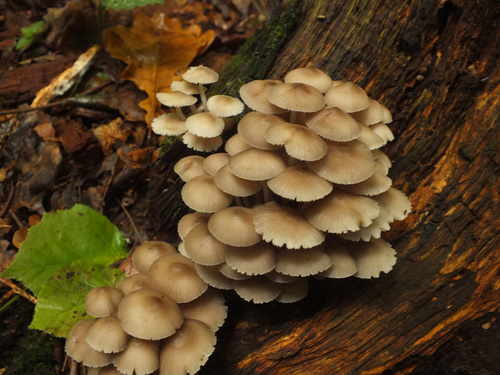
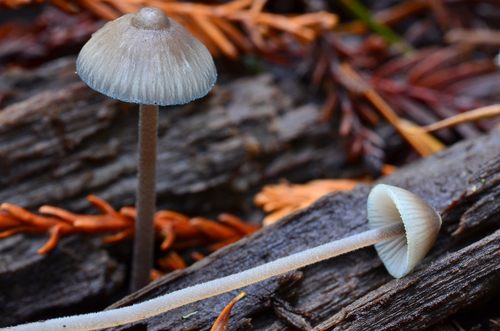
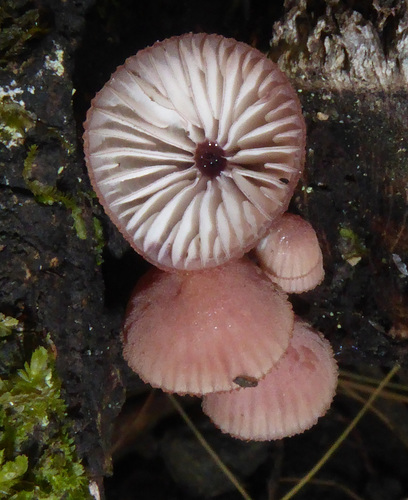
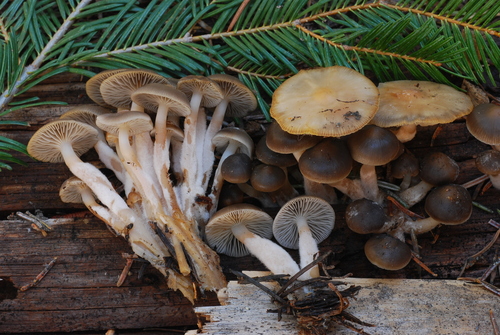
Mycena overholtsii produces some of the largest mushrooms within the genus Mycena. Its caps range from 1.5 to 5 cm (1⁄2 to 2 in) in diameter and are convex in shape, developing a central protrusion called an umbo that resembles a nipple when mature. The cap surface is smooth, moist, and marked with radial striations. Caps are somewhat hygrophanous, and their color ranges from brown or grayish-brown to dark or bluish-gray, depending on the mushroom's age and hydration state. The mushroom's flesh is thin, watery, and light gray in color. The gills can attach to the stem in an adnate, adnexed, or shallowly decurrent arrangement; they are initially closely spaced, becoming well-spaced at maturity. Gills are whitish to pale gray, and stain gray when bruised. Three or four tiers of short, partial gills called lamellulae are interspersed between the full-length gills. The stem measures 4 to 15 cm (1+1⁄2 to 6 in) long by 0.3 to 1 cm (1⁄8 to 3⁄8 in) thick, and tapers upward so the stem apex is slightly thinner than the base. It may be straight or curved, has cartilage-like flesh, and becomes hollow at maturity. When growing on soft, well-decayed wood, the stem often penetrates deeply into the wood substrate. The stem is pinkish-brown; its lower half is tomentose, meaning it is densely covered with white, woolly hairs. This mushroom has a yeast-like odor and a mild taste; its edibility is unknown, but it is not considered poisonous. When viewed as a spore print (spores deposited in mass), spores of Mycena overholtsii are white. Microscopically, spores are roughly elliptical, sometimes bean-shaped, with dimensions of 5.5–7 by 3–3.5 μm. They have thin, smooth walls and bear an indistinct hilar appendage. Spores are amyloid, which means they absorb iodine and turn black to blue-black when stained with Melzer's reagent. The spore-bearing cells (basidia) are four-spored. Cheilocystidia (cystidia located on the gill edge) are scattered, interspersed with basidia, and are roughly cylindrical to fusoid (spindle-shaped). They are smooth, hyaline (translucent), and measure 45–65 by 2–5.5 μm. Pleurocystidia (cystidia on the gill face) are uncommon, and have a similar appearance to cheilocystidia. The cap cuticle is an ixocutis, a type of fungal tissue where gelatinous hyphae lie flat; the hyphae here are mostly smooth and 1.5–3.5 μm in diameter. The cap flesh is dextrinoid, meaning it turns reddish-brown when treated with Melzer's reagent. Clamp connections are present in the hyphae of M. overholtsii. This species is sometimes found growing singly, but more often grows in clusters on well-rotted conifer logs and stumps (often Douglas-fir) near melting snowbanks, or sometimes in moist snow chambers left behind by receding snow. Cool nighttime temperatures slow the rate of snowmelt, which helps ensure spores released by the mushroom disperse into the soil. The mushroom is common in western North America, particularly the Pacific Northwest, the Rocky Mountains and the Cascade Mountains. It has been reported in four U.S. states: South Dakota, California, Washington and Wyoming, and has not been recorded in Oregon. It is also found in western Canada. It is restricted to areas at minimum elevations of 1,000 m (3,300 ft). In 2010, it was reported growing in the boreal coniferous forests of Hokkaido, Japan, in Sakhalin fir (Abies sachalinensis) plantations, as well as in natural forests dominated by both Sakhalin fir and Jezo spruce (Picea jezoensis). In North America, the mushroom usually fruits between March and July; Japanese collections were made in May. The fruiting period can be prolonged, especially in areas with heavy snowfall, or at high elevations where snowmelt is delayed.