About Mycena leptocephala (Pers.) Gillet
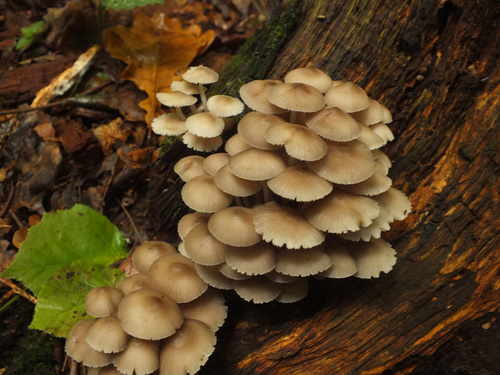
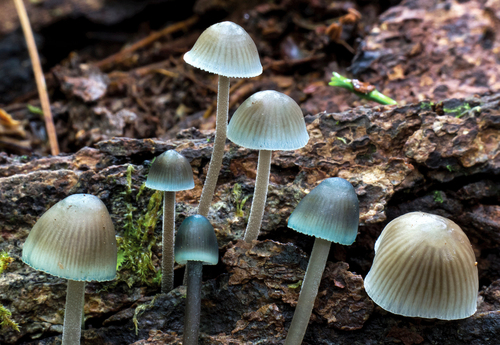
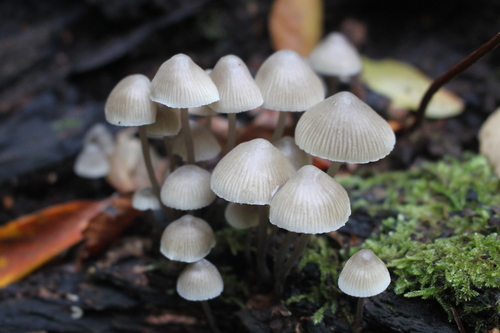
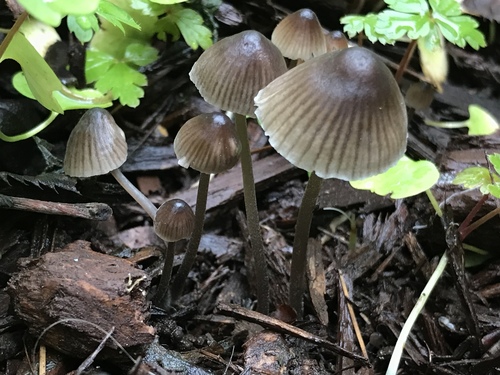
Mycena leptocephala (Pers.) Gillet has a cap that ranges from 1–3 cm (0.4–1.2 in) in diameter. When young, the cap is a thick conical shape, with its margin pressed tightly against the stem. As it expands, it becomes broadly conical to convex, sometimes broadly bell-shaped, or convex with a flaring margin. The cap surface has a whitish sheen from a pruinose coating, which gradually wears away to leave the surface smooth and moist. Faint radial grooves are visible on the cap, marking the position of the underlying gills. After the pruinose coating sloughs off, the cap color is initially dusky brownish-gray to blackish. It soon fades from dark to light gray, ending as ashy-gray. The flesh is thin, fragile, and grayish, with a slightly sour acidulous taste and a weakly alkaline odor that grows stronger when the flesh is crushed. The edibility of this species is unknown, and it is too small to be considered useful for food. The gills are narrow, uniform in width, ascending-adnate, meaning they attach to the stem at much less than a right angle and appear curved upward toward the stem, and toothed. They are spaced subdistantly: 18–27 gills reach the stem, with one or two tiers of short lamellulae (gills that do not extend fully from the cap edge to the stem) interspersed between the full-length gills. Gill color is pallid or cinereous, with even, pale edges. The stem is 3–8 cm (1–3 in) long and 1–2 mm thick, uniform in width along its length, hollow, and very fragile. It is initially bluish-black, darker than the cap, but gradually turns dull brownish-gray before fading to pallid or cinereous. The entire stem surface is densely covered in white pruinose when young, which wears off to leave a polished, translucent surface. The base of the stem is nearly smooth to rather densely covered in white strigose hairs. This species has a distinctive bleach-like odor, and produces a white spore print. Microscopically, the spores are broadly ellipsoid, amyloid, meaning they absorb iodine when stained with Melzer's reagent, and measure 7–10 by 4–6 μm. The spore-bearing basidia are most often four-spored, though two-spored and three-spored forms have been recorded. Two-spored basidia produce spores measuring 11–14 by 6–6.5 μm, while three-spored basidia produce spores measuring 8–10 by 3.5–4.5 μm. Pleurocystidia, cystidia located on the gill face, are scattered, rare, or absent. They measure 30–44 by 9–13 μm, are variable in shape, ranging from fusoid-ventricose to club-shaped, and some have a forked apex. Club-shaped pleurocystidia occasionally develop two or three finger-like prolongations. Cheilocystidia, cystidia located on the gill edge, are numerous and share the same general shape as pleurocystidia. The gill flesh is homogenous, made up of enlarged hyphae that stain vinaceous-brown with iodine. The cap flesh has a well-differentiated outer pellicle, whose cells bear numerous rod-shaped prolongations. The hypoderm, the tissue layer directly under the pellicle, is well-formed, while the remaining internal cap tissue is floccose. All tissue except the pellicle stains vinaceous-brown in iodine. Mycena leptocephala is a saprobic species, meaning it gets nutrients from breaking down dead organic matter. Its fruit bodies grow scattered to gregariously on fallen sticks and needle carpets under conifers, and are quite common in early summer and again in autumn. Fruit bodies can be infected by the bonnet mold Spinellus fusiger. In North America, it is found across Canada in British Columbia, Manitoba, and Nova Scotia, ranging south through Washington to California and North Carolina in the United States. In South America, it has been collected in Venezuela. It also grows in the Archipelago of the Recherche, off the southern coast of Western Australia. In Europe, it is known from Britain, Finland, The Netherlands, Norway, and Spain. It has also been recorded at multiple sites across Asia: the Vindhya Range in India; the Gwangneung Forest Museum in the Korea National Arboretum; and the alpine zone of Changbai Mountain Nature Reserve, Jilin Province, China. It is also found in Arctic and alpine regions including Iceland, Greenland, and the Murmansk region.