About Mycena leaiana (Berk.) Sacc.
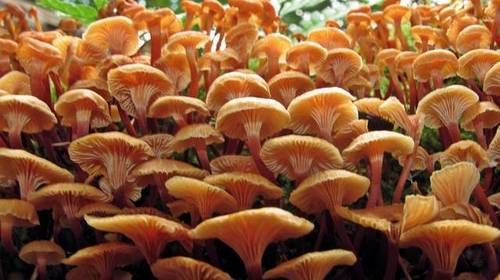
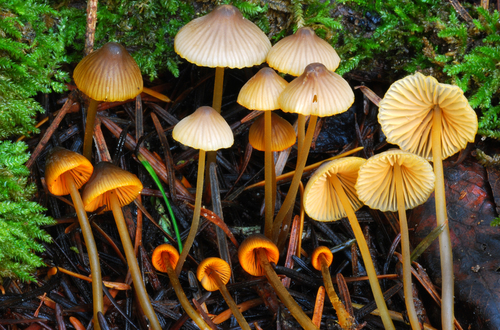
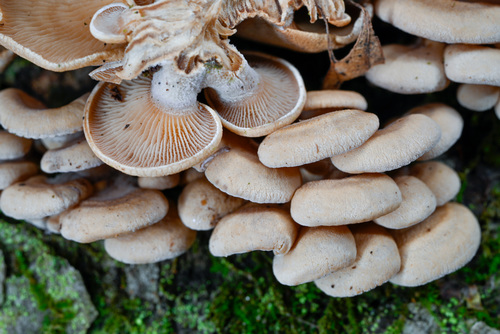
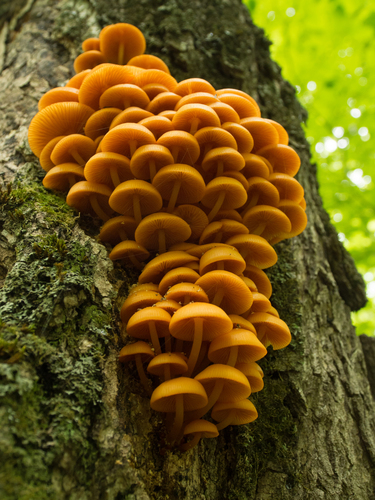
Mycena leaiana, commonly known as the orange mycena, has a hygrophanous cap that ranges from 1 to 4 centimetres (0.39 to 1.57 in) in diameter. When young, the cap is rounded or bell-shaped; as it ages, it expands into a convex shape, and often develops a depression in its center. The cap is bright orange when young, and fades in color as the mushroom matures. Its surface is smooth and sticky, particularly in moist conditions, and the margin of the cap often has visible striations. The trama (flesh) of the mushroom is soft, watery, and white. The gills are adnexed, meaning they are narrowly attached to the stem and taper so they are almost free, and they grow crowded together. They are yellowish in overall color, with edges that deepen to a bright orange-red; this darker edge color comes from an orange pigment mostly contained in special cells called cheilocystidia. If the mushroom is handled, yellow pigment will rub off and stain skin. The stipe (stem) is typically 3 to 7 cm (1.2 to 2.8 in) long and 2–4 mm thick. It is roughly equal in diameter along its entire length, though it may be slightly enlarged at the base. It is orange, with fine hairs on its upper portion and denser hairs at the base. The orange mycena has no distinctive taste, and produces a slightly mealy odor. Its spores are smooth, elliptical, and amyloid, measuring 7–10 × 5–6 μm, and the spore print is white. Mycena leaiana var. australis is a recognized variety of Mycena leaiana found in Australia and New Zealand. It is identical to the main species in all traits except for cap color. When the Australian specimens were first discovered, M. leaiana was only known to occur primarily in the eastern United States, and was completely absent from the Pacific coast of North America. Due to this wide geographic separation, along with the difference in cap color, a new varietal name was proposed for the Australasian specimens. Mycena leaiana is a common species that grows in dense cespitose clusters, where all stems share a single point of origin, on the logs and branches of hardwood trees. It is a North American species, and has been reported across eastern and central United States and Canada. The variety Mycena leaiana var. australis occurs in Australia and New Zealand.