About Mycena inclinata (Fr.) Quél.
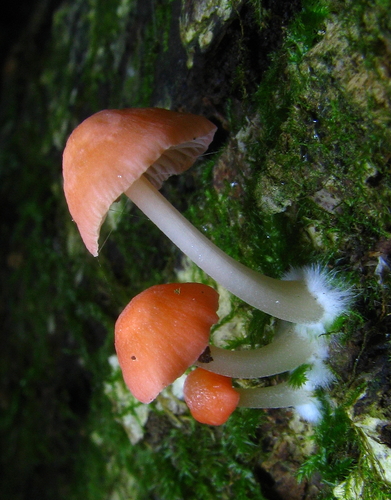
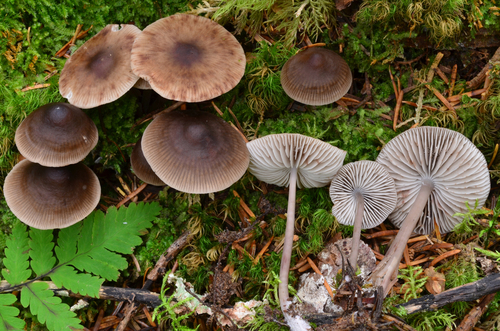
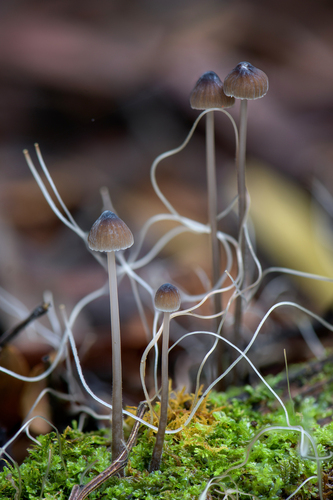
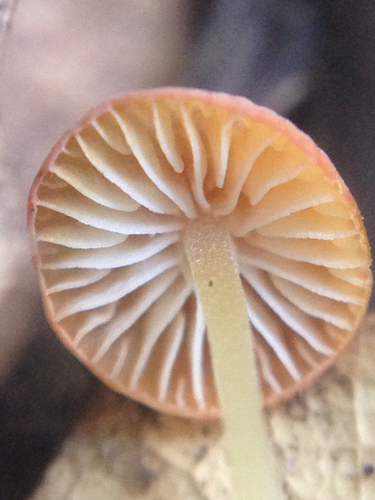
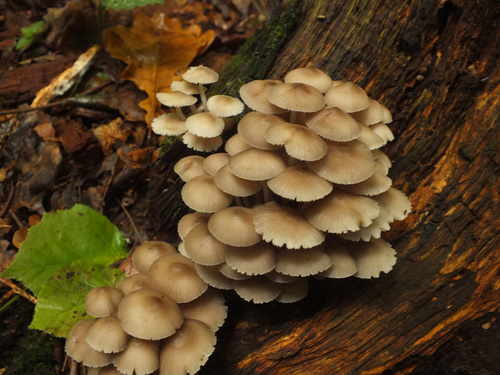
Mycena inclinata (Fr.) Quél. has a light reddish-brown cap, typically 1 to 4.5 cm (0.4 to 1.8 in) in diameter. When young, the cap ranges from conic to bell-shaped to convex; it flattens as it matures, developing visible surface grooves that align with the gills underneath the cap. The cap margin has minute but distinct scallops, its surface is moist, smooth, and hygrophanous, and the cap often develops splits along the margin or cracks on the central disc. The cap flesh is thick at the center and thin elsewhere, grayish to whitish, fragile, and has a slightly mealy odor and taste. The gills attach to the stem in a decurrent arrangement, meaning they run down the length of the stem; they are pale brownish with red tinges, 3 to 6 mm broad, with close to subdistant spacing, and approximately 26 to 35 gills reach the stem. The fragile stem is 3 to 9 cm (1.2 to 3.5 in) long and 0.15 to 0.4 cm (0.06 to 0.16 in) thick, with a yellow to yellow-brown color that becomes reddish-brown to orange-brown in the bottom half as the mushroom matures. The lower portion of young stems is covered in white flecks; the stem is roughly equal in thickness from top to bottom, and its base is covered by yellowish mycelium that can extend up to one-third of the stem's total length. The edibility of this mushroom is classified as doubtful, and consumption is best avoided, though the species is considered nonpoisonous.
For microscopic characteristics: the spores measure 7–9 by 5–6.5 μm, are broadly ellipsoid, smooth, and strongly amyloid (turning black when treated with Melzer's reagent). The spore-bearing basidia are four-spored. Pleurocystidia (cystidia on the gill face) are not differentiated. Cheilocystidia (cystidia on the gill edge) are embedded in the gill edge and very inconspicuous, club-shaped, measuring 26–36 by 5–10 μm, with tips covered in contorted projections that can be either slender or thick. The gill flesh is homogeneous, and stains pale yellowish to dirty brown when treated with iodine. The cap flesh has a distinct pellicle, a well-differentiated hypoderm (the tissue layer immediately under the pellicle), and a filamentous tramal body; it stains pale yellowish to sordid brownish with iodine.
Mycena inclinata is a saprobic fungus that gets its nutrients from decomposing organic matter in plant litter including leaves, twigs, bark, and branches. It does this by producing enzymes that break down the three major biochemical components of plant cell walls found in litter: cellulose, hemicellulose, and lignin. Fruit bodies grow in dense groups or clusters on decaying hardwood logs and stumps, especially oak and chestnut, during spring and autumn. The fungus forms white, woolly mycelium on the surface of decomposing oak leaves, and can occasionally be found growing on living trees. In eastern North America, it is abundant in the region bounded by Nova Scotia, Ontario, Manitoba, Missouri, North Carolina, and New York. It has been recorded in Oregon, but the species is generally rare along the Pacific Coast. Its range also includes Europe, the Canary Islands, North Africa, East Siberia, Japan, Malesia, Turkey, and New Zealand.