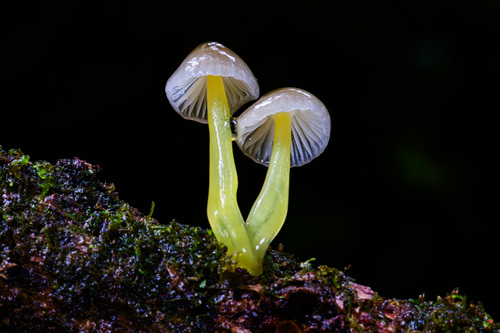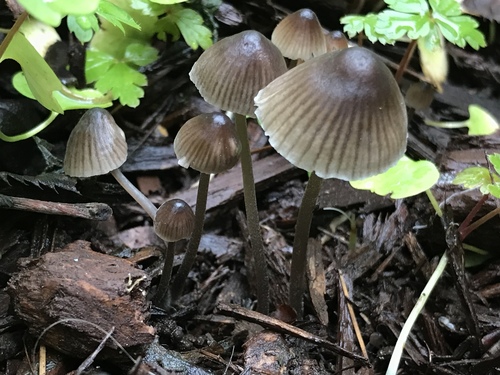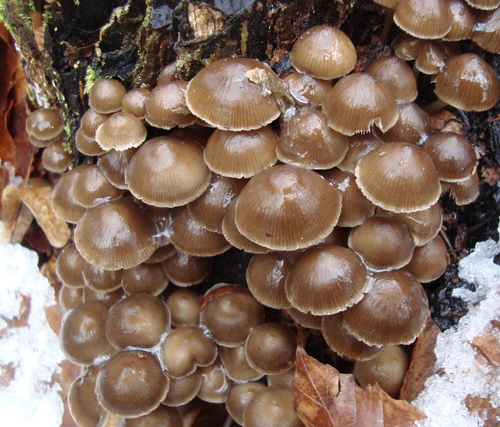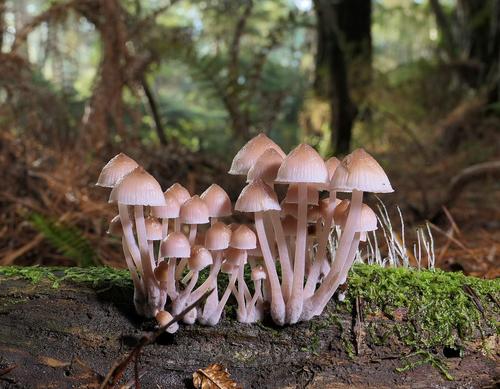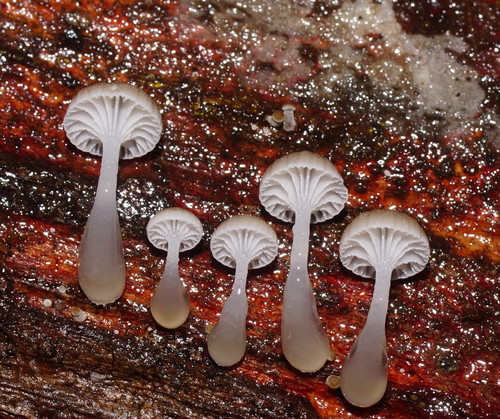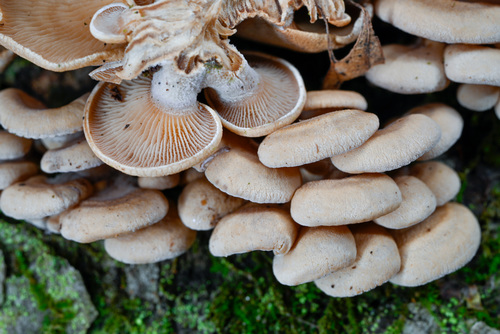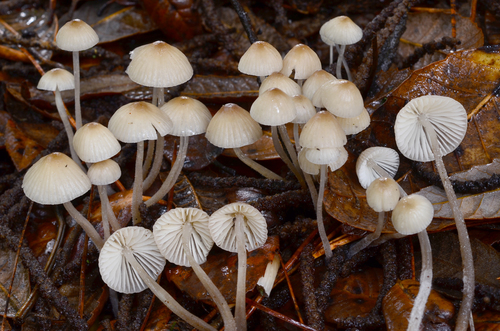
About Mycena galopus (Pers.) P.Kumm.
Mycena galopus (Pers.) P.Kumm. has a cap that is egg-shaped when young, later developing into a conic to somewhat bell-shaped form that reaches 0.5 to 2.5 cm (0.2 to 1.0 in) in diameter. Mature caps often have an inward-curved margin and a prominent umbo. The cap surface initially has a hoary sheen made of remnants of the universal veil that covered the immature fruit body; this sheen quickly sloughs off, leaving the surface naked and smooth. The cap margin, which is initially pressed against the stem, becomes translucent when moist, allowing the outline of the underlying gills to be seen, and develops deep narrow grooves when dry. The cap is mostly fuscous-black apart from a whitish margin that fades to pale gray. The umbo stays blackish or becomes dark gray, sometimes the entire cap is very pale ashy gray when moist, and turns opaque ashy gray after drying. The flesh is thin, soft, and fragile, with no distinctive odor or taste. The gills are subdistantly spaced, narrow, ascending-adnate, and range from whitish to gray, usually darkening with age; their edges are pallid or grayish. The stem is 4 to 8 cm (1.6 to 3.1 in) long (rarely up to 12 cm), 1–2 mm thick, uniform in thickness along its length, smooth, and fragile. The lower stem is dark blackish-brown to dark ashy, the apex is pallid, and the whitish base is covered in coarse, stiff hairs. When broken, the stem exudes a white milk-like liquid. The variety candida matches the main species in appearance except that its entire fruit body is completely white. Variety nigra has a dark or blackish-gray cap and gills that start whitish before turning gray. Although not poisonous, M. galopus and its varieties candida and nigra are inedible. For microscopic characteristics, the spores are 9–13 by 5–6.5 μm, smooth, ellipsoid, occasionally somewhat pear-shaped, and very weakly amyloid. Basidia are four-spored. Pleurocystidia and cheilocystidia are similar in form, very abundant, measure 70–90 by 9–15 μm, and are narrowly fusoid-ventricose, usually with abruptly pointed tips, sometimes forked or branched near the apex, hyaline, and smooth. The gill flesh is homogeneous and stains dark vinaceous-brown in iodine. The cap flesh has a thin but clearly differentiated pellicle, a well-developed hypoderm (the tissue layer directly under the pellicle), and the remaining tissue is filamentous. All cap tissue except the pellicle stains vinaceous-brown in iodine. Mycena galopus is a saprobic fungus that acts as an important decomposer of leaf litter in forest ecosystems. Studies in the UK estimate it accounts for a large portion of autumn leaf litter decomposition in British woodlands. It can break down both the lignin and cellulose components of leaf litter. When grown in axenic laboratory culture, the fungus mycelium degrades hemicelluloses, protein, soluble carbohydrates, purified xylan, and pectin in addition to lignin and cellulose, using enzymes including polyphenol oxidases, cellulases, and catalase. It is particularly skilled at breaking down lignin, which is the second most abundant renewable organic compound in the biosphere, after cellulose. Research indicates the fungus contributes to weathering soil minerals, making them more available to mycorrhizal plants. Phosphorus, a key macronutrient that affects plant growth, typically occurs in primary minerals such as apatite or other organic complexes, and its low solubility often leads to low phosphorus availability in soil. The biological activity of M. galopus mycelium increases the availability of phosphorus and other nutrients, both through soil acidification caused by cation uptake and via the release of weathering agents including low molecular mass organic acids. Studies show the fungus is sensitive to low concentrations of sulphite (SO32−), a byproduct of sulphur dioxide pollution, meaning this pollution can be toxic to the fungus' growth and the resulting leaf litter decomposition at environmentally relevant concentrations. The fruit bodies grow in scattered groups on humus under hardwood or conifer trees. In the United States, it is very abundant along the Pacific Coast from Washington to California, and also found in Tennessee and North Carolina; its northern range extends to Nova Scotia, Canada. In Europe, it has been collected from Britain, Germany, Ireland, and Norway.