About Mycena galericulata (Scop.) Gray
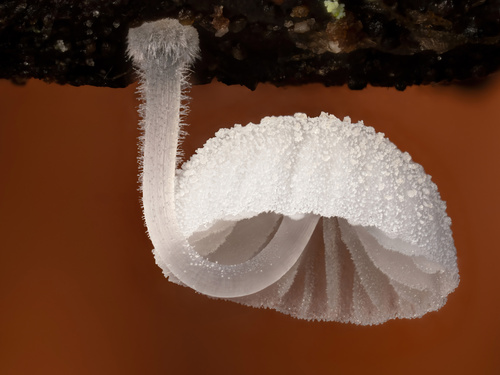
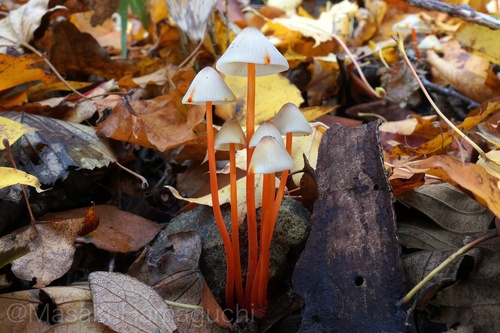
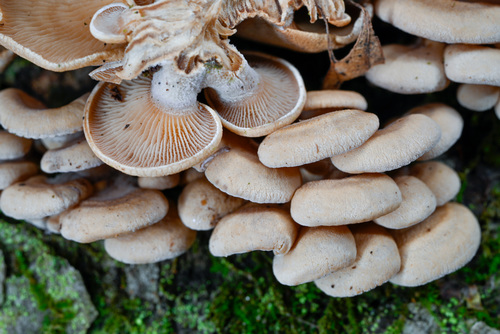
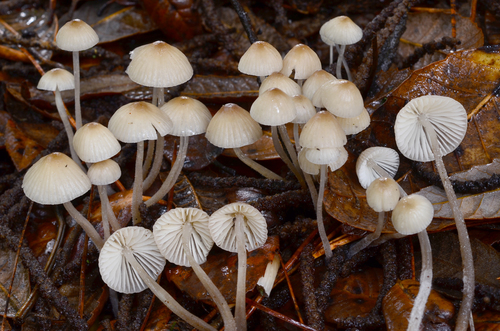
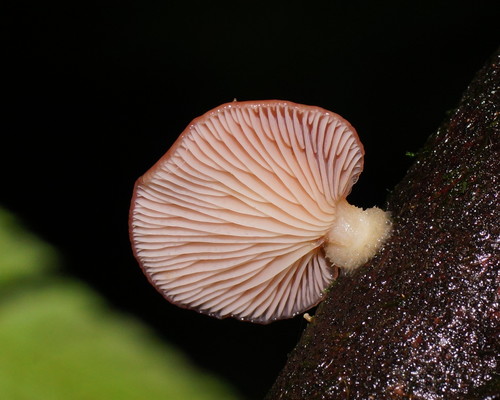
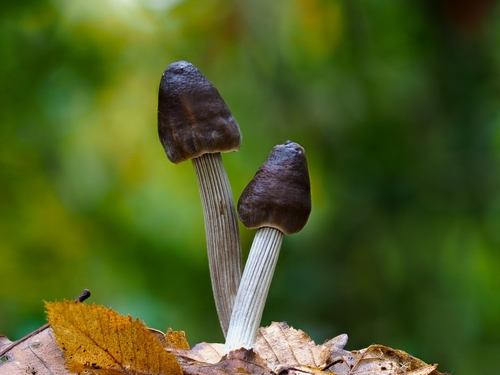
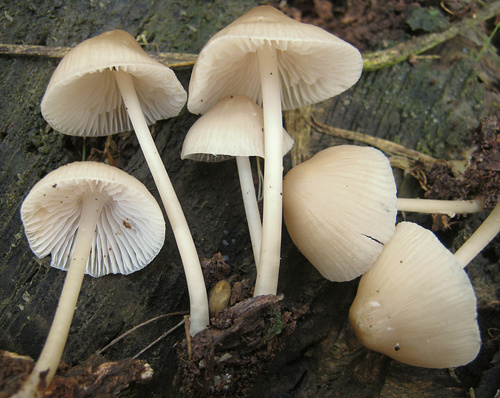
The cap of Mycena galericulata is roughly conical when young, and matures to become broadly bell-shaped or develops a broad umbo, reaching diameters of 2–5 cm (0.8–2.0 in). The cap margin is initially somewhat curved inward, but soon flattens or even becomes uplifted, and often splits radially as it ages. The cap surface has radial grooves that extend nearly to its center, and feels greasy but not sticky. Its color is somewhat buff-brown at the margin, fading gradually to pale dirty tan or dirty cinnamon-brown toward the center. The flesh is thick at the center of the cap and tapers evenly to the margin; it is watery gray, with a cartilage-like texture. Both the odor and taste range from mildly to strongly farinaceous, similar to the smell of freshly ground flour, to radish-like. The gills range from narrowly attached (adnexed) to broadly attached or sinuate. Gill spacing ranges from close to somewhat distant, with 26–36 gills reaching the stem; there are also three or four tiers of lamellulae (short gills that do not extend fully from the cap margin to the stem). The gills are strongly intervenose (have cross-veins), moderately broad at 5–7 mm, and start white or grayish white before soon becoming flushed with pale pink, with even edges. The stem is 5–9 cm (2.0–3.5 in) long, 2–4 mm (0.08–0.16 in) thick, equal in width along its length, and has a cartilaginous texture. It is hollow, hairless, either smooth or marked by twisted longitudinal striations, and often has a long pseudorrhiza, a subterranean elongation of the stem, at its base. The upper portion of the stem is pale grayish white, while the lower portion is pale grayish black; the base turns somewhat dirty brown with age, but does not develop reddish stains. Mycena galericulata produces a whitish spore print. Its spores are ellipsoid, measuring 8–10 by 5.5–7 μm, and amyloid, meaning they turn blue-black to black when stained with Melzer's reagent. The spore-bearing basidia have stout sterigmata, and measure 34–40 by 7–9 μm. They may be either two-spored or four-spored. Numerous club-shaped to rounded cheilocystidia (cystidia on the gill edge) are present, measuring 32–40 by 8–12 μm; their apices or the entire enlarged portion bear rodlike projections that become increasingly elongated and branched as the mushroom ages. There are no pleurocystidia (cystidia on the gill face). Gill tissue has a very thin cuticle, under which lies a narrow hypoderm; the rest of the tissue is made of densely matted tufts of mycelia, and stains deep vinaceous-brown in iodine. Clamp connections are present in the hyphae of four-spored forms. Mycena galericulata is a saprobic fungus that grows on decaying hardwood and softwood sticks, chips, logs, and stumps. It can also grow from submerged wood, which may make it appear to be growing on the ground. It typically grows in small clusters, and sometimes grows singly. It fruits from late spring to early winter. A study of litter-decomposing fungi in a Finnish coniferous forest found that M. galericulata produces extracellular hydrolytic enzymes in humus and eluvial soil, including β-glucosidase, β-xylosidase, α-glucosidase, butyrate esterase and sulphatase. These enzymes form complexes with inorganic and organic soil particles and break down (depolymerize) biopolymers such as cellulose, hemicellulose, and starch, which contributes to carbon and nutrient cycling. Lead contamination in soil reduces both the growth and extracellular hydrolytic enzyme activity of M. galericulata. Mycena galericulata is a very common, widely distributed species found across the entire temperate zone of the Northern Hemisphere. In the United States, it occurs throughout eastern North America and also along the Pacific Coast. It has also been collected in Edo State, Nigeria. While it has occasionally been reported from Australia, these collections are most likely misidentifications. In 2025, the mushroom was collected in China, where it grows on rotten wood and dead coniferous branches in Inner Mongolia, and in central and northeast China.