About Mycena epipterygia (Scop.) Gray
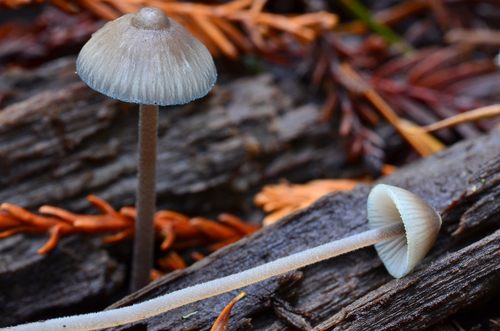
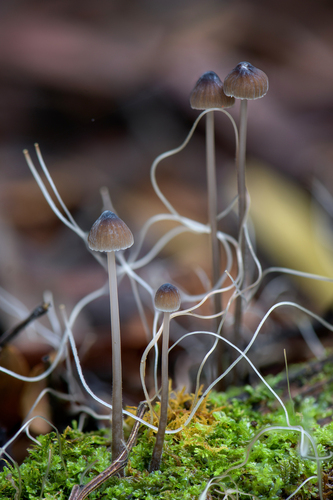
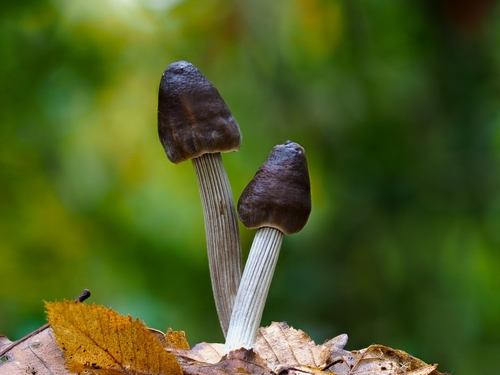
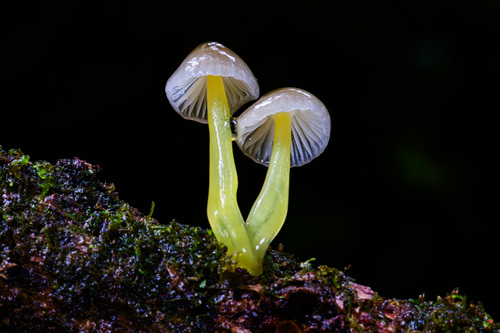
Mycena epipterygia (Scop.) Gray has a striate cap that is initially bell-shaped, later becoming convex, or occasionally nearly flat with a slightly upturned margin. The cap surface is sticky, its cuticle can be peeled off, and it reaches 1 to 2 cm (3⁄8 to 3⁄4 in) wide. Cap colour ranges from yellowish brown to gray-brown, the margin is somewhat irregular, and the flesh is white and fragile. The stipe is long and slender, measuring about 4–9 cm (1+5⁄8–3+1⁄2 in) tall and 1–2 mm wide. It does not taper, and is yellowish to yellow-green, which is an identifying feature of the species. The gills are white to cream, sometimes developing a pink tinge as they age. They are fairly widely spaced, and are either adnate or slightly decurrent. The spores are amyloidic, 8 to 10 micrometres long and 4 to 5.5 micrometres wide. The spore print is white to very pale buff, and the mycelium of this species is bioluminescent. M. epipterygia is a common species in Western Europe, including the Netherlands and Belgium. It grows in deciduous and coniferous woods, heather, and acid grasslands, growing among grasses and mosses on the ground. In Britain, fruiting bodies appear from August to November. In the North American Pacific Northwest, the species appears in groups, growing in needle litter and on wood. This is a saprotrophic species.