About Mycena cystidiosa (G.Stev.) E.Horak
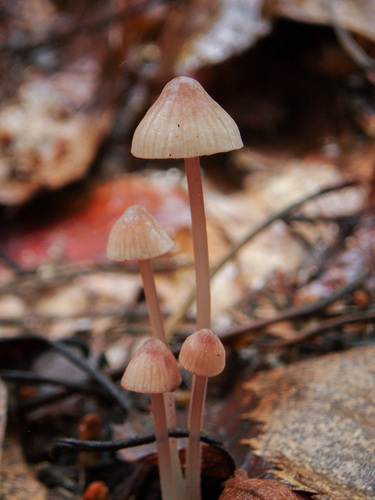
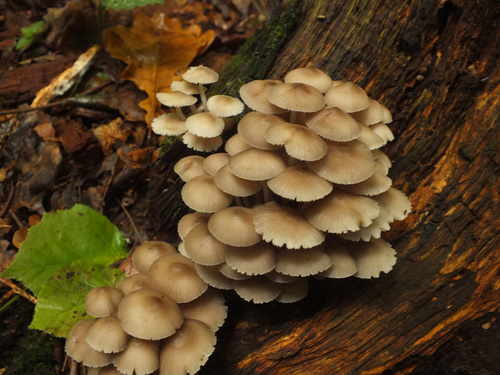
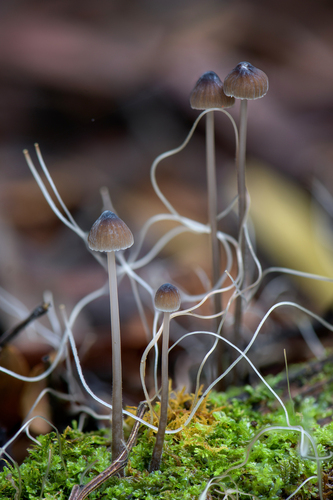
The cap of Mycena cystidiosa is 6–12 mm (0.24–0.47 in) in diameter, light brown with a dark brown umbo. It has indistinct grooves and fluting, with a somewhat velvety texture; the margin is paler and frilled. The flesh is white beneath the umbo, and fawn above the gills. The gills are adnexed and cream-coloured, with some bearing dull pink stains. They are moderately distantly spaced, and covered with cystidia. The stipe is 6–8 cm (2.4–3.1 in) long by 1–2 mm (0.04–0.08 in) thick, though Australian specimens have been recorded growing up to 20 cm (7.9 in) long. It is cream-coloured in its upper portion and brown below, with a smooth surface. The stipe is hollow and brittle, and densely covered with white hairs at the base. Extending from the stipe base are numerous lengthy white rhizomorphs that can reach up to 30 cm (12 in) long, and are terminated by a small cap or knob. The rhizomorphs are organized as linear strands of mycelia, differentiated into an inner portion containing large-diameter 'vessel' hyphae, and an outer cortex made of narrow, thick-walled hyphae. The cap at the end of the strand strongly resembles the developing cap of immature fruit bodies. The spores are 9–10 by 7 μm, amyloid, thick-walled, with an inner wall that resembles the mesh of a sieve. Although the spore surface is smooth, it appears rough due to the irregular shape of the inner wall. The type collection also contained spores half the usual size, which led Stevenson to suggest that there may be both two- and four-spored basidia. Cheilocystidia (cystidia on the gill edge) and pleurocystidia (cystidia on the gill face) are 25–40 by 8–13 μm, very abundant, thick-walled, and stain weakly amyloid in Melzer's reagent. Mycena cystidiosa is a saprobic fungus, meaning it obtains nutrients by breaking down decomposing plant organic matter. While mushrooms of this species are usually found growing on fallen leaves, they can also grow on wood, utilizing the small branch litter common to eucalypt forests. The species may contain the enzymes necessary for decomposing lignocellulosic biomass. It is found in New Zealand, southwestern Australia, and Tasmania. Australian mycologist Bruce Fuhrer calls it "possibly our tallest Mycena". Mushrooms generally fruit from April to June. In a study of post-fire succession in a Eucalyptus regnans forest, researchers found that M. cystidiosa appeared in the third of three phases of recolonization, more than seven years after the burn. Other species of Mycena often found in this "mature" phase include M. austrofilopes, M. austrororida, and M. interrupta.