About Mycena aurantiomarginata (Fr.) Quél.
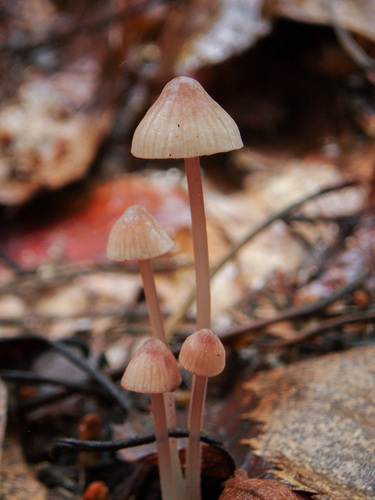
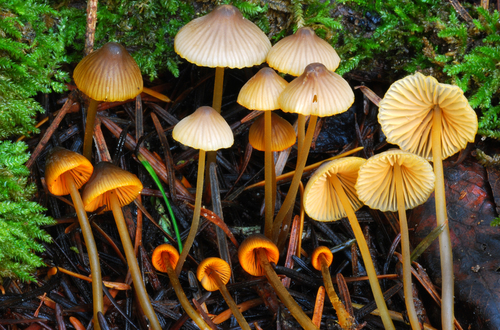
Mycena aurantiomarginata (Fr.) Quél. has a cap that ranges in shape from obtusely conic to bell-shaped, becoming flat when mature, and reaches 0.8–2.0 cm (3⁄8–3⁄4 in) in diameter. Cap color is variable: the center ranges from dark olive fuscous (dark brownish-gray) to yellowish-olive, while the margin is orangish. In his 1947 monograph of North American Mycena species, Alexander H. Smith stated that the caps are not hygrophanous (meaning they do not change color based on hydration level), while Mycena specialist Arne Aronsen says they are. The overall color of the cap fades as the mushroom ages. The cap surface is moist; young mushrooms are covered in fine whitish powder, but this powder quickly sloughs off to leave a polished surface that develops radial grooves when mature. The cap flesh is thin (about 1 mm thick at the cap center) and flexible. The gills are adnate with a decurrent tooth: they curve upward to connect to the stipe, but close to the stipe the gill margin turns downward again. The gills are initially narrow and broaden as the mushroom ages. They are pallid to grayish-olive with bright orange edges. Smith noted that the edge color may spread to the gill faces in some specimens, because the pigment is located in the cytosol (rather than encrusted on the walls of the cystidia), making it more readily diffusible. The gills are spaced closely together, with 16 to 26 gills reaching the stipe, and up to three tiers of short, interspersed lamellulae (gills that do not extend fully from the cap edge to the stipe). The cylindrical stipe is 3–6 cm (1+1⁄8–2+3⁄8 in) long by 0.1–0.2 cm (1⁄32–3⁄32 in) thick, hollow, stiff but flexible, and slightly thicker at its base. Its color is brownish to grayish-olive, sometimes tinged with orange. The stipe surface is smooth except for orange powder near the top, while the base is covered with stiff orange hairs. Smith reports that the mushroom tissue has no distinctive taste or odor, while Aronsen describes the odor as "very conspicuous; sweet, fruity, often experienced as farinaceous or faintly of anise". Like many small Mycena species, the edibility of M. aurantiomarginata is unknown, and it is too insubstantial to be considered for collection as food. The spores are elliptic, smooth, and amyloid, with dimensions of 7–9 by 4–5 μm. The basidia (spore-bearing cells of the hymenium) are club-shaped, four-spored, and measure 25–32 by 5.5–7 μm. Pleurocystidia (cystidia on the gill faces) and cheilocystidia (cystidia on the gill edges) are abundant and have similar morphology: they are club-shaped to somewhat capitate (with a distinct head), their tops are sparsely to densely covered with small spines (a structure described as resembling a mace), they are filled with bright orange pigment, and they measure 28–36 by 7–12 μm. The cap flesh is covered by a cuticle, with scattered cystidia similar to gill cystidia found on the cuticle surface. Directly under the cuticle is a layer of enlarged cells, and beneath this layer are filamentous hyphae. Clamp connections are present in the hyphae. M. aurantiomarginata uses a tetrapolar mating system, in which genes at two different locations on the chromosomes regulate sexual compatibility (mating type). This system prevents self-fertilization and ensures a high degree of genotypic diversity. When fungal mycelia are grown in culture on a petri dish, the colonies are white, odorless, and typically have a central patch of congested aerial hyphae that grow upward from the colony surface; these hyphae abruptly become flattened and submerged, and occasionally form faint zone lines. Hyphae commonly form deposits of tiny amorphous crystals where they contact other mycelial fronts, especially when the hyphae are vegetatively incompatible and destroy each other by lysis. M. aurantiomarginata is a saprobic fungus that gets nutrients from decomposing organic matter on the forest floor, such as fallen needle carpets. Its fruit bodies grow scattered, in groups, or in tufts under conifers (usually spruce and fir), and are often found growing on moss. In North America, it occurs in California, Washington, Oregon, and British Columbia, and it is widely distributed across western and northern Europe. In Central America, it has been collected on the summit of Cerro de la Muerte in the Cordillera de Talamanca, Costa Rica, growing on leaf litter of Comarostaphylis arbutoides, a highly branched evergreen shrub or tree in the heath family. In 2010, it was reported from Hokkaido in northern Japan, where it was found growing on Picea glehnii forest litter in early winter. It has also been recorded from North Africa.