About Mycena arcangeliana Bres.
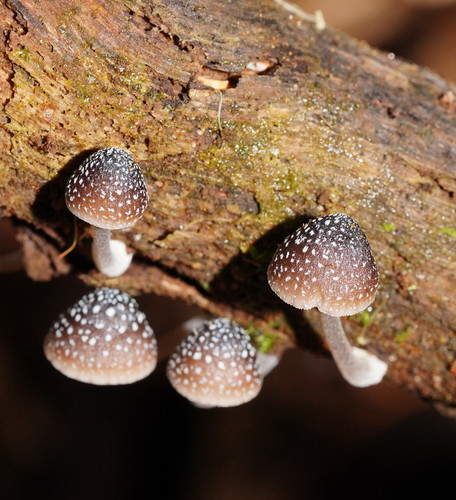
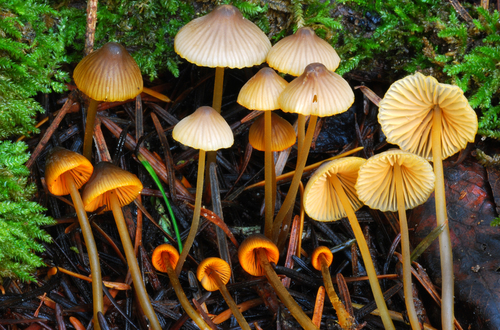
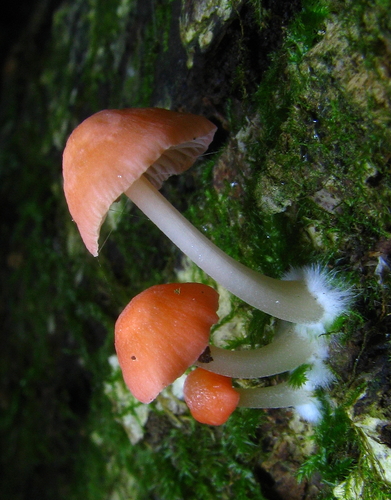
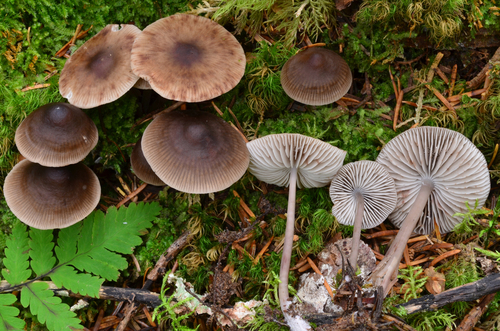
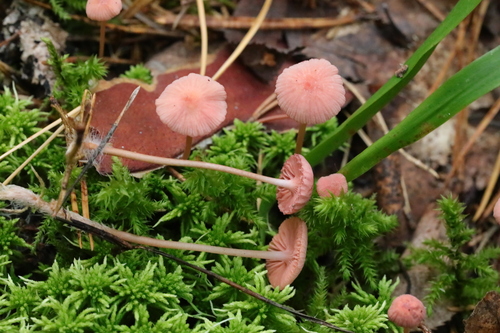
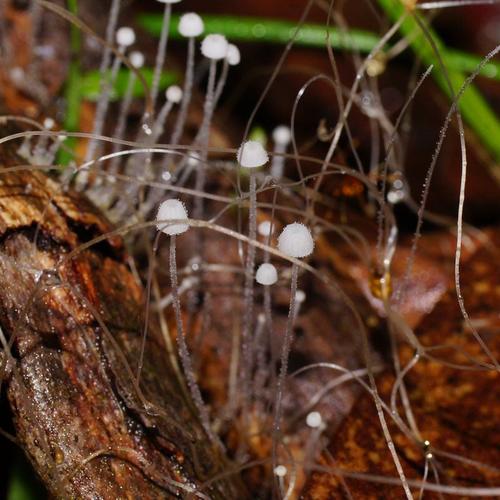
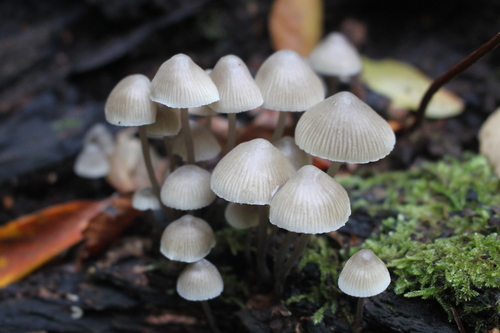
Mycena arcangeliana Bres. mushrooms have caps 1 to 5 centimetres (0.4 to 2 inches) in diameter. Young specimens have conical caps, which become bell-shaped with a broad umbo in older mushrooms; the oldest individuals have almost completely flat caps. Cap colour ranges from whitish to darker grey-brown, sometimes with olive or yellow tints, and furrows mark the typically translucent surface. This species is hygrophanous, so dried caps fade to a much paler colour. The cylindrical stem is 20 to 40 millimetres (0.8 to 2 inches) long and 1 to 2 millimetres (0.04 to 0.08 inches) wide. Young stems are olive-grey with lilac tints, and this colour fades as the mushroom ages. The very top of the stem is whitish, while the base is covered in white hairs. The stem has a smooth, silky texture, and bears no ring. The crowded gills are adnexed, meaning only part of their depth connects to the stem. They start white and turn pinkish as the mushroom ages, and their edges are somewhat toothed. The flesh has a mild taste, a strong odour of iodoform, is white within the cap and grey within the stem. Mycena arcangeliana is not edible. For microscopic characteristics, Mycena arcangeliana produces a whitish spore print. Its spores are shaped like apple seeds, are amyloid (they stain dark in Melzer's reagent or Lugol's solution), and measure 7 to 8 micrometres by 4.5 to 5 micrometres. The basidia are four-spored. A large number of hyaline cheilocystidia, cystidia found on the gill edge, are club-shaped or ovate, have thin cell walls, and are covered in grain-like warts. Pleurocystidia, cystidia on the gill face, have a similar appearance. The pileipellis is formed of wart-covered hyphae 2 to 4.5 micrometres wide and up to 30 micrometres long. The outermost layer of the stem consists of hyphae with short, cylindrical hairs, and all hyphae have clamp connections. Mycena arcangeliana grows on dead deciduous wood, with a preference for beech and ash, and grows in small troops. It has also been recorded less frequently on conifers, bracken, and Japanese knotweed. Reports of this species from grassland are almost certainly misidentifications of M. flavescens. It occurs from late summer to autumn in the British Isles, where it ranges from infrequent to common, and is more commonly found in the southern part of the region. It is fairly widespread across the rest of Europe, though less common outside the British Isles. It is listed as vulnerable on the Red List of Threatened Fungi in Norway. While "Mycena oortiana" was rarely referenced in mycological literature and described as a predominantly west-European species, M. arcangeliana has also been recorded in Scandinavia, Greenland, and Italy; the species was first described from Italian specimens.