About Mycena albidocapillaris Grgur. & T.W.May
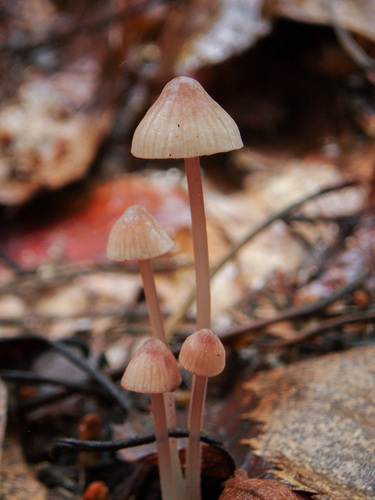
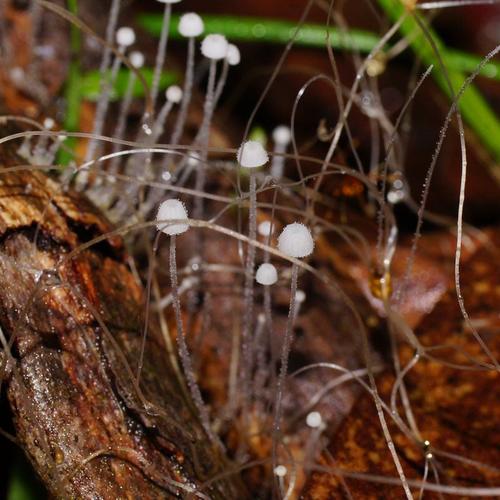
Mycena albidocapillaris is a mushroom species in the family Mycenaceae that occurs in Australia. It was first formally described scientifically in 1933 by mycologist John Burton Cleland, who gave it the name Mycena subcapillaris. The original type collection of this species was collected in 1922 on Mount Lofty. Later, it was determined that Cleland's chosen name was invalid, because Paul Hennings had already published and used the name Mycena subcapillaris in 1899, giving that name priority. In 1997, Cheryl Grgurinovic and Tom May republished the species under the new replacement name Mycena albidocapillaris. The fungus produces small, delicate fruit bodies. These fruit bodies have caps that range in color from white to brownish, with a diameter of 3–5 mm (0.12–0.20 in). Caps are supported by a slender stipe that is translucent to whitish, and grows up to 30 mm (1.2 in) long. On the underside of the cap, the gills are few in number and spaced fairly far apart. This fungus produces fruit bodies in groups, growing on leaves, twigs, stigs, and decaying fern fronds.