About Mycelis muralis (L.) Dumort.
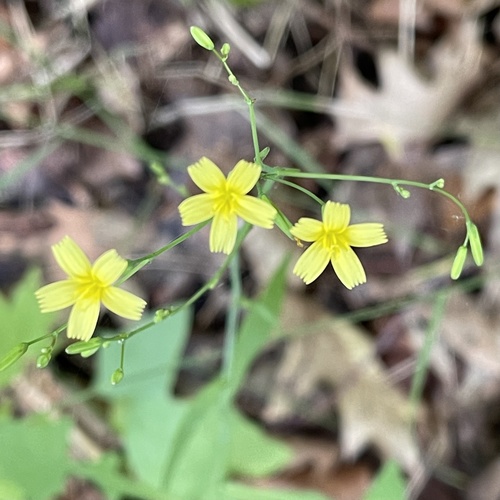
This species, currently referred to as Mycelis muralis (L.) Dumort. and also known as Lactuca muralis, is a slender, hairless herb that reaches a height between 25 and 150 cm (10 to 59 inches). Its stems are often purplish, and the plant exudes a milky juice when cut. Lower leaves are lyre-shaped and pinnate, with triangular lobes where the terminal lobe is the largest. Upper leaves are stalkless, smaller, and have fewer lobes than lower leaves. All leaves are tinged with red. The achenes are short-beaked, spindle-shaped, and black. The pappus is made of simple white hairs, with inner hairs longer than outer hairs. The small yellow flower heads hold only 4–5 yellow ray florets, and are roughly 1 cm (1/2 inch) wide. They grow on branches that grow at 90 degrees to the main stem, arranged in a loose panicle. Flowering occurs from June to September. Lactuca muralis resembles Lactuca serriola L. and Lactuca virosa L., but can be clearly distinguished by having only 5 florets. Lactuca muralis is native to Europe, but has invaded shady roadsides, paths, and logged areas of the Pacific Northwest and New England. It became naturalized in parts of Northern Ireland as early as 1913. It was first recorded in The Burren in 1939, where it is now frequent. Habitats where it can be found include woodlands, especially beech woodland, calcareous soils, and on walls.