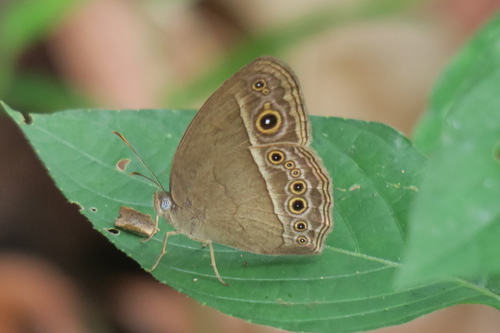
About Mycalesis visala Moore, 1857
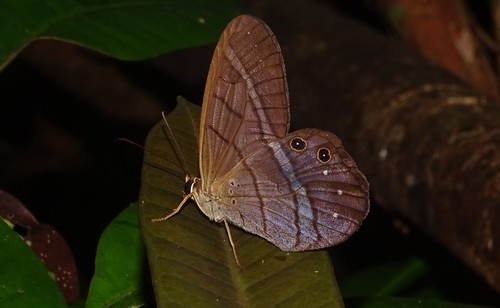
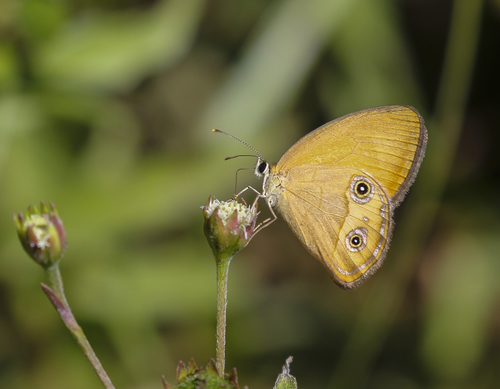
Both seasonal forms of Mycalesis visala Moore, 1857 closely match Mycalesis mineus in body color and wing markings. Overall, M. visala is typically larger than M. mineus. For the continental M. visala form (not the insular race), both sexes can generally be distinguished from males and females of related species by the shape of the forewing: the forewing is usually elongated and forms an acute apex, while the termen below this apex is sharply transverse. Additionally, male M. visala have a distinct sex-mark on the underside of the forewing that is a rather bright ochraceous color, and is very long, extending past the transverse bands that cross the wings. The race Mycalesis visala andamana Moore has a male forewing underside sex-mark identical to that of the main M. visala form. For both seasonal forms and both sexes of race andamana, all wing shapes are much more rounded, closely resembling the wing shape of M. mineus in this characteristic. However, the base wing color of race andamana is darker than that of M. mineus, and its ocelli are proportionately larger. The arrangement of the ocelli in race andamana appears fully consistent. On the upperside of race andamana, the forewing has two ocelli, with the posterior ocellus being the larger of the two. Males of this race have no ocelli on the upperside of the hindwing, while females have one faint, obscure ocelli here. On the underside of race andamana, both sexes have two ocelli on the forewing and seven ocelli on the hindwing. The posterior four of the hindwing ocelli are arranged the same way as they are in M. mineus.