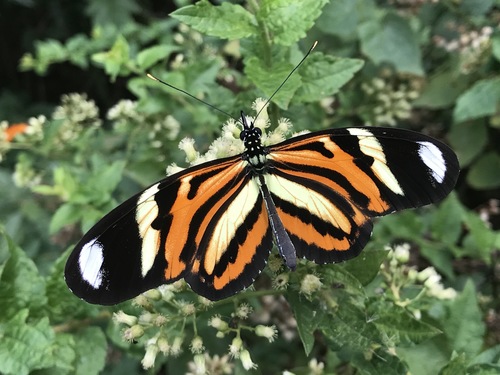
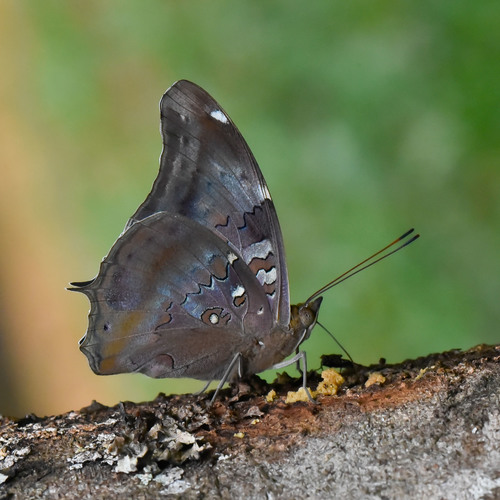
About Mycalesis perseus Fabricius, 1775
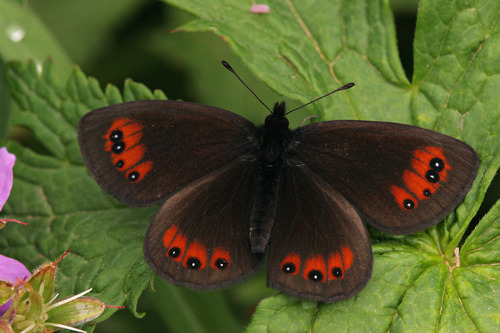
Mycalesis perseus shows seasonal dimorphism, with clearly distinct wet-season and dry-season forms. Wet-season form (both male and female): The upperside ranges from dark to somewhat pale vandyke-brown. The fore wing has a black ocellus with a white center and fulvous ring in interspace 2, and very rarely has an extra small similar ocellus in interspace 5. The hind wing is uniformly colored, and occasionally has two or three obscure postmedian ocelli. Both fore and hind wings have pale subterminal and terminal lines. The underside has the same ground color and same pale subterminal and terminal lines as the upperside, but is crossed by a shared narrow purplish-white discal fascia. The fore wing has two to four ocelli, and the hind wing normally has seven ocelli; these ocelli match the type seen on the upperside, but are more clearly defined. On both wings, the line of ocelli is bordered on the inner and outer sides by sinuous purplish-white lines. On the hind wing, only the three posterior ocelli lie in a straight line, while the remaining ocelli curve strongly outwards. On the upperside of the female's fore wing, the median or posterior ocellus is always larger than the matching ocellus in the male. Dry-season form (both male and female): The upperside is similar to that of the wet-season form, though the median ocellus is generally smaller. The underside is brown, more or less suffused with purple and speckled with tiny darker brown transverse strigae. The transverse discal band is obscure, often only marked by black dots at the veins, and occasionally bordered on the outside by a diffuse ochraceous band. The ocelli are usually reduced or absent, but when present as tiny dots they follow the same arrangement on the hind wing as in the wet-season form. Antennae, head, thorax, and abdomen are all brown; the sides of the antennae are sometimes cinereous white, with a black apex. Male sex-marks follow form 2, and the sex-mark on the underside of the fore wing is small, black, and about 2 inches long. The wingspan of this species ranges from 42 to 54 mm.