About Mycalesis mineus Linnaeus, 1858
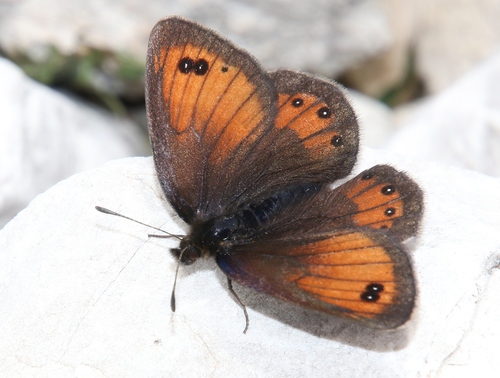
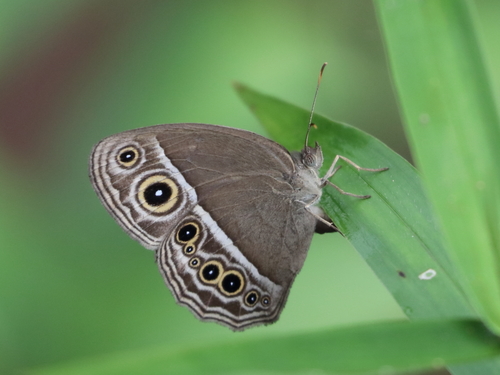
This species is Mycalesis mineus Linnaeus, 1858. The wet-season form has dark Vandyke brown upperside. Both forewings and hindwings have slender pale subterminal and terminal lines. The forewing has one black ocellus centered white and ringed fulvous, which is usually set in a square pale area in interspace 2; occasionally, a similar smaller ocellus without a surrounding pale area appears in interspace 5. The hindwing is uniform, and sometimes has one or two obscure postmedian ocelli. The underside has a similar ground color. A transverse dusky-white discal band with a clear inner edge and diffuse outer edge crosses both forewings and hindwings. This band is followed by a postdiscal series of ocelli surrounded by a dusky-yellowish, sometimes purplish white, line. These ocelli match those on the upperside; forewings have between two and four ocelli, while hindwings have between five and seven, where the preapical two may be underdeveloped. On the hindwing, four posterior ocelli lie in a straight line, unlike the three aligned ocelli found in Mycalesis perseus. Beyond the ocelli rows on both wings are pale or purplish-white sinuous subterminal and terminal lines. The dry-season form has a paler upperside that is otherwise similar to the wet-season form. Its underside ranges from ochraceous brown to a darker dusky brown shade, with the basal half of the wings noticeably darker than the outer portions. The entire wing surface is irrorated (sprinkled) with fine brown striae. Sometimes, a distinct dark discal band crosses both wings. Ocelli are nearly obsolete, marked only by minute white specks, while the four posterior ocelli on the hindwing remain in a straight line as seen in the wet-season form. Antennae, head, thorax, and abdomen are brown. The antenna club has black and ochraceous markings. The male sex-mark is of form 1, matching that seen in M. perseus, but the patch of specialized scales on the underside of the forewing is half as large again as that of M. perseus.