About Mycalesis anaxias Hewitson, 1862
Scientific name: Mycalesis anaxias Hewitson, 1862
Wet-season form, for both males and females: The upperside is dull Vandyke brown, and is paler in females. Both forewings and hindwings have fine fulvescent (tawny) subterminal and terminal lines; cilia are brown. The forewing features a short oblique white preapical band that does not quite reach either the costa or the termen.
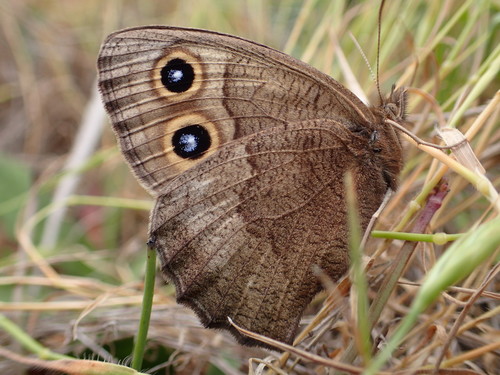
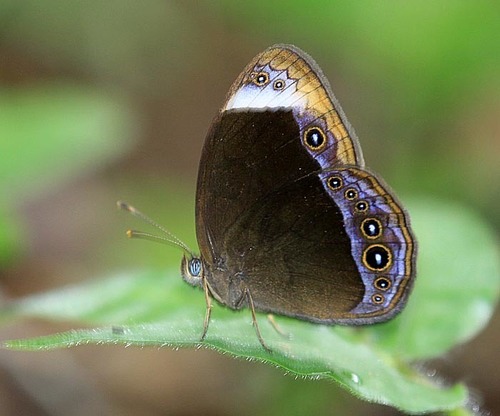
For the underside: On the forewing, the basal area extending up to the white band, along with a transverse line running from the lower end of the band to the dorsum, is blackish brown. The terminal margin beyond this area is broadly paler brown. There is a black ocellus with a white center and fulvous ring in interspace 2, plus two smaller similar preapical ocelli. These are followed by a very sinuous subterminal dark brown line and a straighter terminal dark brown line. On the hindwing, the basal two-thirds is blackish brown, and the terminal border is broadly paler. This terminal border normally holds seven ocelli that match those on the forewing, along with subterminal and terminal dark brown lines.
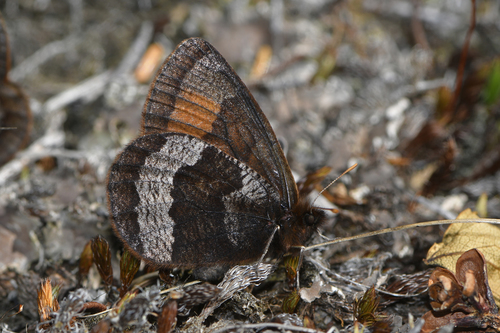
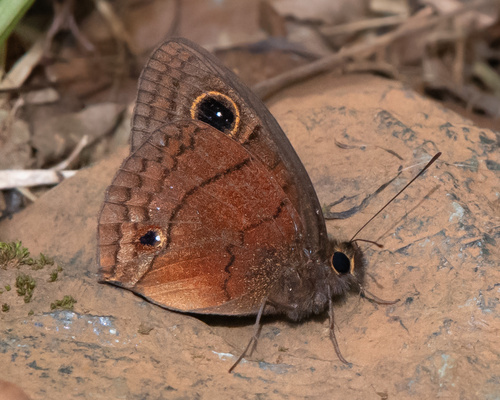
Dry-season form: The upperside matches that of the wet-season form. The underside differs because ocelli are either indistinct or entirely absent, and the subterminal and terminal dark lines on both the forewing and hindwing are either absent or very faint. The terminal margins are broadly rufescent (reddish) brown, fading inwardly to a lilacine tone. The oblique white bar on the forewing is diffuse along its outer edge.
Antennae, head, thorax, and abdomen are dark brown; antennae are ochraceous toward the apex. Wingspan ranges from 51 to 60 mm. The male sex-mark belongs to form 1.