About Myadestes unicolor P.L.Sclater, 1857
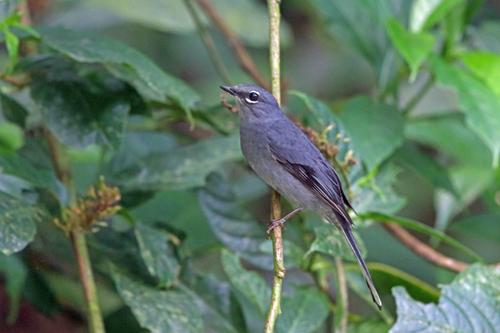
Myadestes unicolor, commonly called the brown-backed solitaire, is 19 to 20.5 cm (7.5 to 8.1 in) long and weighs 30 to 44 g (1.1 to 1.6 oz). Males and females have identical plumage. Adults are mostly slaty gray, with underparts that are slightly paler than upperparts. They have a broken white eye-ring, blacker primary coverts, black flight feathers with buff edges, and whitish gray outer tail feathers. Their bill is dark, and their legs and feet are yellowish. Juveniles have a buffish "moustache" marking. Their upperparts bear black-edged buff spots, and their underparts have whitish buff feather centers that create a scaly appearance. The brown-backed solitaire has a disjunct distribution across several separate mountainous regions. One population occurs in Mexico from southern San Luis Potosí to central Oaxaca, and a second Mexican population is in Veracruz. A third population ranges from Chiapas, Mexico south into central Guatemala, a fourth is in Belize, and the final population extends from southern Guatemala south across extreme northern El Salvador, most of Honduras, and into north-central Nicaragua. This species lives in cloudforest, pine-oak forest, and montane evergreen forest within tropical and subtropical zones. Different sources report conflicting elevational range limits for the species. Two sources give the range as 800 to 2,500 m (2,600 to 8,200 ft) and 900 to 1,500 m (3,000 to 4,900 ft). Two other sources report the species occurs from near sea level up to 2,700 m (8,900 ft).