About Myadestes ralloides (Orbigny, 1840)
Scientific name: Myadestes ralloides (Orbigny, 1840), commonly called the Andean solitaire.
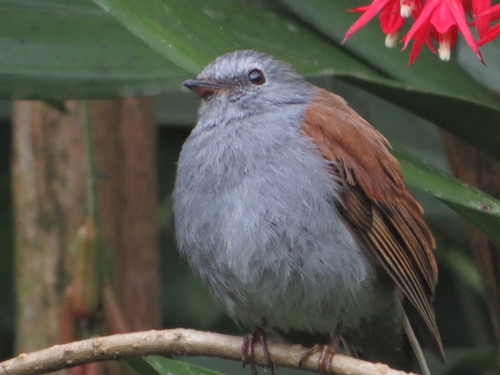
Description: Adult Andean solitaires measure 17 to 18 cm (6.7 to 7.1 in) in length and weigh 25.5 to 37 g (0.90 to 1.3 oz). Males and females have identical plumage. For the nominate subspecies M. r. ralloides, adults have a dull grayish olive crown, black lores, and an otherwise dull medium gray face. Their back, rump, and uppertail coverts are reddish brown. Their wings are also reddish brown, with dark tips on the primary coverts and dark bases on the secondaries. Their tail is reddish brown, with white inner webs on the outer feathers. Their underparts are dull medium gray. Nominate adults have a dusky bill and pale brown legs. Juveniles are similar in appearance to adults, but have pale buff spots on the upperparts and dark stippling on the underparts.
Each of the other recognized subspecies has distinct plumage traits compared to the nominate. Subspecies M. r. plumbeiceps has richer brown upperparts than the nominate, along with a gray crown and a dark yellow base to the mandible. M. r. candelae has a dark tawny crown and upperparts, and a darker gray breast than the nominate. M. r. venezuelensis is a brighter, tawnier brown on the upperparts than the nominate; it also has a gray forehead, a brown crown, more olive flanks, and yellowish legs.
Distribution and habitat: The Andean solitaire has a disjunct distribution across the Andes mountain range, with each subspecies occupying a separate range. M. r. plumbeiceps is found in the Western and Central Andes of Colombia, and ranges south through most of western Ecuador. M. r. candelae is restricted to the Magdalena River valley in north-central Colombia. M. r. venezuelensis occurs in the Serranía del Perijá along the Colombia-Venezuela border, the Venezuelan Coastal Range from Carabobo to northern Miranda, and the Andes from Táchira south through eastern Colombia and eastern Ecuador into Peru as far as the Marañón River. The nominate subspecies M. r. ralloides is found along the eastern slope of the Andes from the Marañón River in Peru south to Chuquisaca Department in central Bolivia.
The Andean solitaire inhabits humid foothill and mountain forest, as well as mature secondary forest. It appears to prefer areas near ravines and mountain streams. Its elevation range varies by location: it occurs mostly between 900 and 2,800 m (3,000 and 9,200 ft) overall, and has been recorded accidentally as high as 4,500 m (14,800 ft) in Venezuela. In Colombia its range spans 350 to 2,800 m (1,100 and 9,200 ft). In eastern Ecuador it occurs mostly between 1,000 and 2,500 m (3,300 and 8,200 ft), and occurs at lower elevations in western Ecuador. In Peru it occurs mostly between 1,200 and 2,900 m (3,900 and 9,500 ft), and is found locally as low as 600 m (2,000 ft).